
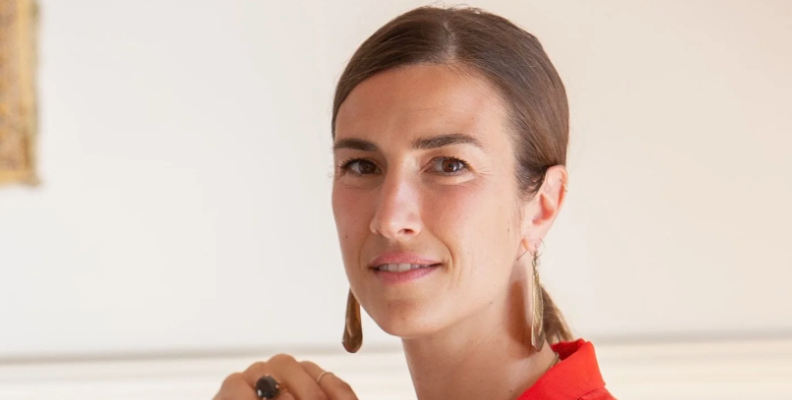
















Danielle Alvarez Built Small Business Legal Solutions for Creators and Founders
December 30, 2025

Written by
Please share a brief introduction and your business:
I’m Danielle Alvarez, a transactional attorney and the founder of Small Business Legal Solutions (SBLS), a flat-fee law firm built specifically for entrepreneurs and growing small businesses. I help founders protect what they’re building through clear, accessible legal support—without surprise billing or legal confusion.
Before becoming an attorney, I was a small business owner myself and ran a brick-and-mortar dance studio. That experience shaped everything I do today. I built SBLS because I know firsthand how hard it is to make legal decisions when you don’t have approachable, affordable legal resources—and I wanted to change that for other founders.
I’m based in Florida and serve clients nationwide, working primarily with service-based business owners, creators, consultants, and agency owners who are scaling and want their legal foundation to scale with them.
Did you always know you wanted to be an entrepreneur?
Yes—being an entrepreneur has always felt like a natural path for me. I’ve always been drawn to building, creating, and having ownership over the work I do. Even before law, I was already running a brick-and-mortar dance studio, managing a team, and growing a business from the ground up.
That experience confirmed what I already knew about myself: I thrive in environments where I can build something meaningful, make independent decisions, and take full responsibility for the outcome. Becoming an attorney didn’t change that—it simply gave me a new, powerful way to serve entrepreneurs through my own business.
Are you a mamaprenista?
Yes, I’m absolutely a Mamaprenista—and my honest advice is to release the idea of doing everything perfectly. Building a business and raising a family at the same time requires constant adjustment, grace, and a willingness to let different seasons look different.
The biggest shift for me was learning to operate with clear priorities instead of chasing balance every single day. Some days my kids need more of me, and other days my business does—and I stay grounded by remembering that long-term consistency matters more than daily perfection.
Practically, I rely on strong systems, clear boundaries, and support. I plan my work intentionally, protect family time, and I’m not afraid to ask for help. Most importantly, I involve my family in the journey so they understand why I’m building—and so they feel part of it, not separate from it. You can grow a serious business and be an engaged parent. It doesn’t require sacrificing one for the other—it requires intention, structure, and a lot of self-trust.
Take us back to when you launched? What was your marketing strategy?
When I first launched, my primary marketing strategy was networking and relationship-building. I focused on building genuine connections, having real conversations, and letting word-of-mouth do the heavy lifting rather than relying on paid ads or large-scale campaigns.
It actually went better than I expected. Because the growth was rooted in trust and referrals, the clients who found me were already aligned with my values and the way I practice. That foundation helped me build early momentum in a way that felt sustainable and authentic to me.
What accomplishments are you the most proud of to date in your business?
One of the accomplishments I’m most proud of is helping a creator avoid signing away her entire intellectual property portfolio and even the rights to her own name. She came to me just before signing a contract that, on the surface, looked like a huge opportunity—but buried in the fine print were provisions that would have permanently transferred ownership of everything she had built.
We were able to stop the deal, renegotiate the terms, and protect her ownership so she could continue to build her brand on her own terms. Seeing her keep control of her work, her future, and her identity was incredibly meaningful to me—and it perfectly reflects why I built this firm in the first place.
What is one thing you wish you had known when you started your Entreprenista journey?
I wish I had learned sooner to stop listening to imposter syndrome. In the early stages, it’s easy to question your readiness, your expertise, or whether you truly “belong” in the room—but those doubts can quietly delay growth for years if you let them.
Looking back, I realize I was far more prepared than I gave myself credit for. Confidence isn’t something you wait for—it’s something you build by showing up before you fully feel it. If I had trusted myself earlier and moved through the uncertainty faster, I would have grown even more quickly.
What did you go before starting your own business?
Before launching Small Business Legal Solutions, I built my legal career in transactional law with a focus on mergers & acquisitions and entertainment law. I worked on structuring deals, negotiating contracts, and supporting high-growth businesses and creators through complex transactions—experience that gave me a deep understanding of how businesses operate at both the startup and scaling stages.
Even before practicing law, I was a small business owner running a brick-and-mortar dance studio, which gave me real-world exposure to the operational, financial, and legal challenges founders face every day. That combination—hands-on entrepreneurship and high-level transactional legal work—shaped the way I approach my practice today and ultimately led me to build a firm designed specifically for entrepreneurs.
What made you take the leap to start your own business?
Accessibility was the driving force behind starting my firm. As a former small business owner, I knew how difficult it was to find legal support that felt approachable, affordable, and transparent. Too often, quality legal help is either out of reach financially or wrapped in layers of complexity that make founders feel hesitant to ask questions.
After working in M&A and entertainment law, I saw firsthand how well-resourced companies had entire legal teams guiding every move—while small business owners were left to figure things out on their own. I built Small Business Legal Solutions to change that dynamic by offering flat-fee, education-forward legal support that entrepreneurs can actually access and understand.
I didn’t want legal protection to feel like a luxury. I wanted it to feel like a core part of building a real, sustainable business—at every stage.
Do you have any recent wins?
This past year, one of my biggest wins was helping a service-based founder restructure her business legally as she crossed into six figures in revenue. We cleaned up her contracts, formed the proper entity structure, and put strong protections in place for her team and client relationships—all before she brought on her first full-time hire.
Since then, she’s been able to scale with confidence, take on larger clients, and step into a true CEO role without constantly worrying about legal exposure. Watching that transition from “scrappy founder” to protected, structured business owner was incredibly rewarding and a huge reminder of why this work matters.
Who are your customers?
My customers are small to mid-sized business owners who are serious about protecting and scaling their companies. I primarily work with service-based founders, consultants, agency owners, creators, and digital entrepreneurs who need clear, reliable legal support as they grow.
Many of my clients are at a turning point—hiring their first team members, launching new offers, entering partnerships, or signing larger contracts—and they want to do it with confidence, structure, and clarity instead of risk and guesswork.
What's your top productivity tip?
My top productivity tip is non-negotiable time blocking. I plan my week in advance and assign specific tasks to specific blocks of time so I’m never reacting to my day—I’m directing it. This has been the single biggest factor in allowing me to run multiple businesses without burning out.
What's your favorite business tool?
My favorite business tool is my CRM, and case management system, MyCase, because it centralizes everything—clients, communications, documents, deadlines, and workflows—in one place. It allows me to operate efficiently, maintain a high level of client experience, and scale without letting things fall through the cracks. Strong systems give me back time, protect my focus, and allow me to run my business with clarity instead of constant reaction.
What's your approach to work-life balance?
I view balance as something that shifts by season rather than something that stays perfectly even all the time. There are periods where my business requires more of my focus, and others where my family takes the lead—and I give myself permission to move fluidly between the two without guilt.
What keeps it sustainable is strong boundary-setting and intentional planning. I’m very clear about when I’m “on” for work and when I’m “off” for family, and I protect both with the same level of respect. Integration, for me, means building a business that supports my life—not one that competes with it—so I can be fully present in both roles.
How do you avoid burn-out?
Family time is my biggest anchor and my strongest safeguard against burnout. No matter how demanding work becomes, protecting intentional time with my husband and kids is non-negotiable for me. It’s what keeps me grounded and reminds me why I’m building in the first place.
I’m also very conscious about creating boundaries around my schedule so work doesn’t quietly expand into every corner of my life. Stepping away to be fully present at home allows me to come back to my business with clarity, energy, and perspective. For me, rest isn’t separate from productivity—it’s what sustains it.
What advice do you have for aspiring Entreprenistas?
Start before you feel ready—and expect to evolve as you go. Clarity comes from action, not overplanning. The most successful founders I know didn’t wait for perfect timing, perfect confidence, or perfect conditions. They built while learning.
Also, take your business seriously from the beginning. Put real structure around what you’re building, charge appropriately for your value, and surround yourself with people who are expanding their vision alongside yours. Community matters, but so does discernment.
Finally, remember that there is no single “right” way to build. Your business should support your life, not consume it. Trust your instincts, stay consistent, and give yourself permission to grow into the next version of both your business and yourself.
Learn more about the Entreprenista League and join today
About the Author
Entreprenista League

The Latest

Allison Walsh Closes the Authority Gap for Accomplished Women
The founder of She Believed She Could has advised more than 300 private clients on turning expertise and credibility into visibility, influence, and income.

Elizabeth Watson Helps Founders Recover Their Lost Energy

Automate Your Site with a 1-Month Free Trial
Kartra