
















How Nicole Reed Built Reed Press, an Editorial Studio Where Human Stories Get Human Care
May 27, 2026

Written by
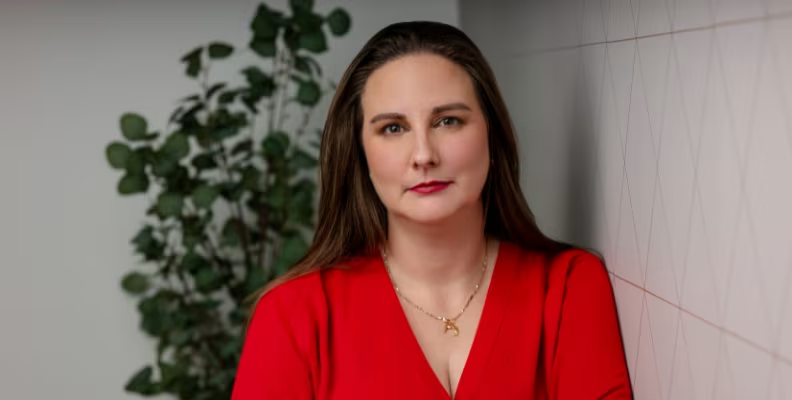
Nicole Reed is building a place where writers are treated like the people they are and the stories they entrust get the level of care they deserve.
Nicole Reed is the Founder and Principal of Reed Press, an editorial studio offering everything from developmental editing and author coaching to websites and publishing preparation. She is an editor, a publisher, and, in her own words, a lifelong lover of stories. The company is built around one simple principle.
"Human stories deserve human care."
Reed Press is what that principle looks like applied to a working studio, with a publishing imprint, Gremlin Books, that started before Nicole was ready and refused to wait.
The Background That Was Always Pointing Here
Before founding Reed Press, Nicole spent nearly twenty years in journalism, publishing, and editorial leadership.
"I worked in newspapers, magazines, and digital media during a period when the entire industry seemed to be changing in real time," she says.
She watched newsrooms shrink, print operations consolidate, and editorial budgets compress. But what stayed with her was the work itself.
"I loved deadlines. I loved hearing people's stories. I loved walking into interviews having no idea where the conversation might lead. One day I might be talking to someone preserving the oldest working forge in Texas, and the next I could be interviewing a ranching family trying to stop a high-speed rail project from cutting through generational land."
Over time, she became increasingly uneasy watching editorial rigor and human nuance get pushed aside in favor of speed and automation.
"AI can absolutely support operational work," she says, "but I think we are already seeing what happens when human creativity, editing, and intellectual property protections are treated like inconveniences instead of essential parts of the process. The English language is too nuanced and the human experience too rich to reduce entirely to algorithms and sound bites."
The Heart Attack That Made the Decision
"In late 2024, my husband suffered a massive heart attack during back surgery connected to injuries from his military service," Nicole says. "He spent a long time in the ICU, and during those weeks and months, books became both comfort and escape for me."
She revisited old favorites and discovered new ones, and in the middle of all that fear and exhaustion, she realized how important stories really are.
She held onto her corporate role for another six months because leaving a stable paycheck is terrifying no matter how strong the conviction. What kept pushing her forward was the people.
"The author who says I love you at the end of a coaching call because you helped them untangle a chapter that had been haunting them for months. The small business owner who was laid off before Christmas and trusted us to help launch her new company into the world. The family historian trying to preserve generations of stories, songs, and poems before they disappear."
She closes the reflection plainly.
"Those are not just clients to me. Those are people trying to leave something meaningful behind."
The Editor as Multilingual Voice Holder
Nicole's framing of the editing craft is one most clients have never heard.
"I often tell clients that editors are multilingual in a strange way. We hold many voices in our heads at once and help strengthen them without flattening what makes them unique."
"We are not interested in turning every writer into the same polished, market-tested voice. We are interested in helping people become more fully themselves on the page."
The honesty extends to the work itself.
"I still lose track of time when I am deep in a manuscript. There is something magical about watching an idea sharpen and unfold in real time."
The Imprint That Started Before It Was Ready
One of the most interesting things about Reed Press is that it accidentally became a publishing house.
"At first, I kept telling clients that publishing was a future goal and that we were focused entirely on editorial services for the time being. But several authors came back and said they wanted to wait until our imprint existed because they wanted the same sense of connection and support from a publisher that they experienced through Reed Press as editing clients."
"So I said, ok, I guess we are doing this, and Gremlin Books officially began moving forward this year with our first author."
Who Reed Press Serves
The client profile is broad and specific at the same time.
"Most of our clients are writers, creatives, entrepreneurs, and researchers who care deeply about what they are building but need someone to help them shape it into its strongest form," Nicole says.
The range is wide. Completed novels. Brand-new ideas without a structure yet. Academic manuscripts. Family histories. Small businesses that need their website voice to actually match the people behind it.
She is also clear about what good editing actually is.
"A lot of people misunderstand what editors actually do. There is this misconception that editing is either grammar correction or forcing everyone into the same voice. In reality, good editing is much more collaborative and intuitive than that. Sometimes we are fixing structure, pacing, or clarity. Sometimes we are pointing out where a thought got lost halfway through a paragraph or where a character has essentially been abandoned in the desert somewhere. And sometimes we are simply helping a writer trust their own instincts."
The Accomplishments That Matter Most
When asked what she is most proud of, Nicole names trust.
"The level of trust people have placed in us in such a short amount of time."
"One of our recurring clients is someone I knew professionally years ago. When she decided it was finally time to develop her generational manuscript, she told me I was the only editor she considered contacting. Out of all the people she could have chosen, she trusted me to help protect and shepherd her family's stories into the world. There is something incredibly humbling about that kind of trust."
The Gremlin Books emergence is the second one.
"Initially, I kept telling clients that publishing was a future goal. But several authors came back and said they wanted to wait until our imprint existed because they wanted the same sense of connection and support from a publisher that they experienced through Reed Press as editing clients."
"It showed me that people are not just looking for technical editing anymore. They are looking for thoughtful partnerships with people who genuinely care about the work."
The Year That Mostly Lived Inside a Manuscript
The recent wins are mixed.
"This past year has felt like a strange combination of chaos, exhaustion, excitement, and validation," Nicole says.
While building Reed Press, she also finished a longtime educational goal.
"In May, I graduated from Texas A\&M University School of Law with a Master of Legal Studies in Intellectual Property, and shortly before graduation I was asked by the faculty to deliver the commencement address on behalf of the master's students."
The full-circle moment was speaking about AI, intellectual property, and the future of publishing while simultaneously building a company centered around those exact conversations.
The other meaningful change was opening her calendar to standalone author coaching clients outside of traditional editing services. The response has been encouraging.
"Some of the biggest wins have simply been the moments where clients tell us they feel understood. Those moments matter more to me than numbers on a spreadsheet right now."
Burnout Prevention as a Creative Discipline
The warning sign is recognizable to anyone who edits for a living.
"Most creative people eventually realize that burnout and writer's block are cousins. For me, the warning sign is when I read the same sentence three times in a row and it still does not register. That usually means it is time for a tea break, a walk around the block, or simply shutting the computer and stepping away for awhile."
She also protects client capacity carefully.
"I try very hard not to overload my calendar with back-to-back client calls. Even when the conversations are interesting, there is still emotional energy involved in showing up fully for people, and I want every client to feel like they are getting the best version of me rather than the exhausted version that is glancing at the clock."
The off-work life is purposefully eclectic. Boxing. Horseback riding. Constant reading. A 1963 Austin Healey replica with the wiring of an American V8.
"It is a wonderfully ridiculous car."
What She Wishes She Had Known
"I wish I had understood just how heavy the emotional side of entrepreneurship could feel," Nicole says. "I had already held executive leadership roles before starting Reed Press, so I thought I understood responsibility, but building something entirely your own is different. There is no buffer. The doubt follows you home."
The financial layer is honest too.
"Looking back, securing additional funding or creating a larger runway earlier would have relieved a great deal of stress during those first months."
She also names the loneliness most founders carry quietly.
"Everyone celebrates the leap, but very few people talk openly about the quiet moments afterward when you are sitting alone with the weight of payroll, expectations, and uncertainty."
What She Would Tell Newer Founders
The advice is firm.
"Please ignore the hustle culture clichés. Fake it till you make it, rise and grind, and all the other slogans that treat human beings like machines are not sustainable ways to build a meaningful life or business."
The reframe she offers about pace is editorial.
"I tell authors all the time that publishing one book late in life is not failure. Some of the greatest literary works in history were published after the author died, and some brilliant writers only produced one major work in their lifetime. They are still successes."
She closes with the line worth keeping.
"Your business does not need to look like someone else's version of success. It needs to reflect your values, your goals, and the life you actually want to live. Protect your story and protect your peace because those are the things that will ultimately sustain you."
What's Next for Reed Press and Gremlin Books
The next chapter is growth that does not lose the human core.
"I hope Reed Press continues growing organically while staying deeply personal in how we approach both creativity and client relationships," Nicole says. "I never want us to become the kind of company where people start feeling like invoices or account numbers instead of human beings trusting us with meaningful work."
For self-published authors, she wants Reed Press to provide long-term editorial guidance. For academic writers, the studio is a place to maintain rigor without losing voice. For traditionally published authors, it is the polishing partner before a book reaches the world. For small businesses, it is a thoughtful voice partner.
Gremlin Books is its own track, growing alongside the editorial studio with its first author already in motion.
The cultural vision is the part Nicole protects most carefully.
"Everyone on our team is a reader first. We love books, storytelling, language, and creativity, and I want that passion to remain at the center of the company no matter how much we grow."
She closes the roadmap with the line that summarizes the entire company.
"At the end of the day, I want people to look at Reed Press and Gremlin Books and know that the stories placed into our care were handled thoughtfully by people who genuinely loved the work."
If Nicole's approach to building an editorial studio rooted in human care, intellectual property awareness, and the long arc of meaningful creative work resonates, the Entreprenista League is a community of women founders who value connection, shared experience, and practical business insight as they grow.
About the Author
Entreprenista League

The Latest
Heather Lillico Helps Burnt-Out Founders Rewire Their Nervous Systems
The former nutritionist burnt out building her nutrition business, and the tools that brought her back to calm now anchor her coaching for women founders.

Elizabeth Watson Helps Founders Recover Their Lost Energy

Automate Your Site with a 1-Month Free Trial
Kartra