
















The Pitch Structure That Gets Media Responses (and Why Most Don’t)
March 31, 2026

Written by
KJ Blattenbauer
Hearsay PR
Most founders assume media pitching is about writing the right email. Editors experience it very differently.
Because in practice, pitching is about helping an editor move a story forward.
Editors don’t respond to outreach because it’s polished. They respond because it clarifies something they’re already trying to explain to their audience.
That means the structure of a strong pitch has less to do with formatting—and everything to do with perspective.
Strong Pitches Start with What’s Changing
The fastest way to lose an editor’s attention is to begin with an introduction.
“I’d love to introduce myself…”
Or “I’m the founder of…”
Even, “My company helps…”
These openings explain who you are. They don’t explain why the pitch matters right now.
Editors are looking for signals of relevance immediately.
Strong pitches usually begin with something closer to, “Here’s what I’m seeing change inside my industry right now…”
That tells an editor the message is timely, not promotional.
Strong Pitches Explain a Pattern, Not Just an Opinion
After relevance comes interpretation.
Editors aren’t just looking for commentary. They’re looking for people who can help them explain what a shift means for their audience.
This is where many pitches become too general.
Instead of describing services or background, strong pitches describe patterns:
- What founders are struggling with
- What customers are changing
- What expectations are shifting
- What assumptions are no longer working
When a pitch helps clarify a pattern, it becomes easier to place inside a story.
Strong Pitches Make Placement Obvious
Editors don’t just decide whether a pitch is interesting. They decide whether they can use it.
Strong pitches make that decision easier.
That often means briefly clarifying:
- What angle you can speak to
- What audience the insight applies to
- What type of story the idea fits inside
The goal isn’t to write more. It’s to remove uncertainty.
When editors can quickly see where your perspective fits, responses happen faster.
The Structure Most Founders Expect (and Why It Doesn’t Work)
Many founders assume a pitch should look like this:
- Introduction
- Credentials
- Company description
- Offer to contribute
This structure makes sense from a business perspective. It doesn’t work from an editorial one.
Editors are not selecting sources based on who someone is. They’re selecting sources based on what someone helps them explain.
Perspective comes first. Background supports it, not the other way around.
The Structure Editors Actually Respond To
Strong pitches follow a quieter structure:
- They open with relevance.
- They clarify a pattern.
- They make placement obvious.
This works because it mirrors how editors think.
Not how businesses introduce themselves.
The Question That Improves Every Pitch
Before sending outreach, it helps to ask one question, “What story does this help an editor write?”
When the answer is clear, pitching becomes dramatically easier.
Because the strongest pitches don’t introduce a business. They position someone as a source.
And once editors begin recognizing you as a source instead of a company, the role PR plays in your visibility changes completely.
About the Author
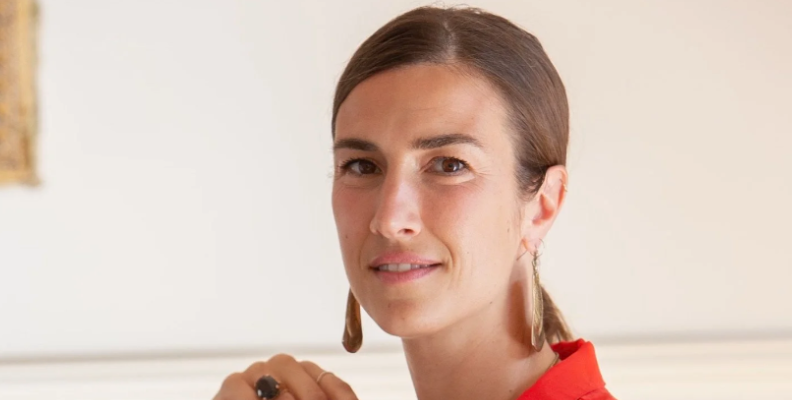
KJ Blattenbauer
Hearsay PR
KJ Blattenbauer is a powerhouse publicist, author, and visibility strategist who helps founders move from “best-kept secret” to in-demand authority. With nearly three decades of PR experience, she’s known for her sharp messaging, no-nonsense strategy, and ability to turn a founder’s story into press that actually drives revenue. As the founder of Hearsay PR and the author of Pitchworthy, KJ has shaped national narratives for brands across business, lifestyle, and leadership.
Her work blends editorial storytelling with actionable strategy, giving women entrepreneurs the clarity, confidence, and media presence they need to grow on their own terms. A trusted voice inside multiple founder communities, KJ is committed to making visibility feel strategic—not stressful—and believes every woman has a story worthy of being recognized.

The Latest

Allison Walsh Closes the Authority Gap for Accomplished Women
The founder of She Believed She Could has advised more than 300 private clients on turning expertise and credibility into visibility, influence, and income.

Elizabeth Watson Helps Founders Recover Their Lost Energy

Automate Your Site with a 1-Month Free Trial
Kartra