

.avif)







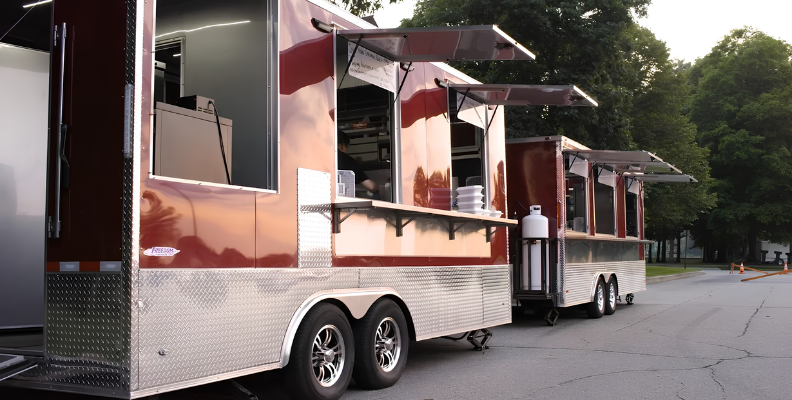
We Reengineered the Entire Food Truck Model and Created a New Category in High-Volume Food Service
How a high-volume event food service platform eliminated long lines, bottlenecks, and limited food options to deliver the food truck experience guests were hoping for.
September 4, 2026

Written by
Julie Cassens
My Food Truck Event
Food trucks were supposed to be fun. Instead, the traditional model created three problems the industry had accepted for decades: long lines, service bottlenecks, and limited food options.
We eliminated all three. We made the guest experience the #1 priority, then reverse-engineered the entire process to deliver it.
We engineered the operation around one question: What does it take to give hundreds of people the food truck experience they were hoping to have?
At one event, we served 1,200 meals in approximately 75 to 90 minutes.
The problem was never the food; it was the design
Traditional food trucks were never engineered for hundreds of people arriving at the same time. A traditional single-service-point food truck is typically limited by its operating process to approximately 30 to 50 meals per hour.
Now put 300, 500, or 1,000 employees in front of it. The math simply does not work.
At a corporate event, the demand is immediate. The capacity is not. The standard solutions are predictable: add more trucks, reduce the menu, extend the service time, or ask people to wait.
We rejected all four. Instead, we built a high-volume event food service platform around multiple points of service, synchronized kitchen workflows, and clearly defined employee roles.
We did not start with the limitations of a traditional food truck and ask how to make it faster. We started with the guest experience we wanted to deliver and engineered backward from there.
We eliminated the single-line model
MFTE’s multi-point serving platforms were engineered to eliminate the traditional single-line bottleneck and dramatically increase high-volume throughput. Fast service does not come from rushing. It comes from removing bottlenecks.
A traditional food truck may serve approximately 30 to 50 meals per hour through one point of service. Our three-window platform can serve up to 400 meals per hour. Our two-window platform can serve approximately 200 meals per hour. Our indoor-outdoor Truckette can serve approximately 300 meals per hour. Together, they create seven points of service.
At one event, we served 1,200 meals in approximately 75 to 90 minutes. Each guest receives food in approximately 20 to 25 seconds. That is not an incremental improvement. It is a different operating model.
No line chaos. No service bottleneck. The truck was not the innovation. The operating system behind it was.
The real product is certainty
In 2025, 76% of our revenue came from recurring clients. Our clients are not simply buying lunch. They are buying certainty.
Certainty that hundreds of employees can be served within the scheduled service time. Certainty that the event will not be defined by one long line. Certainty that the experience they planned is the experience their employees actually get.
The opportunity is bigger than one company
National corporate caterers, food-service management companies, universities, venues, amusement parks, convention centers, and other large-scale operators already have what it takes to serve high-volume groups. They have kitchens, employees, logistics, and customers.
What many do not have is a proven operating system designed specifically for speed, predictable throughput, and high-volume execution. That creates an opportunity to increase revenue from existing customers, differentiate the event experience, and enter a food-service category competitors have not mastered.
The demand already exists. The missing piece is the process. We did not set out to build another food truck company. We set out to give people the food truck experience they were hoping to have in the first place.
So we made the guest experience the priority and engineered everything backward from there. In the process, we re-engineered the entire food truck model, and created a new category in high-volume food service.
About the Author
Julie Cassens
My Food Truck Event
Julie Cassens is the Founder and CEO of My Food Truck Event, a Metro Detroit-based private event foodservice company that has redefined what high-volume food truck service can look like. A former corporate and wedding event planner, Julie saw the same problem over and over: long lines, slow service, limited menu options, and frustrated guests. Instead of accepting that as “just how food trucks work,” she built a new operating model around "Speed, Volume, and an Experience." Under her leadership, My Food Truck Event developed a multi-window, high-capacity service system capable of serving hundreds of guests in tight event windows without the typical line chaos.
The company now serves major corporate events, weddings, grad parties, and large private gatherings with a recurring client base and a proven operational playbook. Julie writes from the perspective of a founder who accidentally created a new foodservice category — one built on solving real event problems, challenging industry assumptions, and turning operational innovation into enterprise value.

The Latest

Three Master's Degrees, a Doctorate, and Still Afraid to Sell: Where Fear of Failure Really Starts
I hold a doctorate and have lived on three continents, yet a test I failed at age 5 still shows up whenever someone questions what I know. If you dread selling, an earlier version of you may be running the room, and she can be released.
Elyce Arons, Frances Valentine: Building Two Iconic Brands and Finding Joy in Chapter Two

Automate Your Site with a 1-Month Free Trial
Kartra