
















Skincare for Busy People: What Matters, What Doesn’t, and What Can Wait
From ingredient confusion to influencer hype, skincare has become unnecessarily complex. This article simplifies skin health so busy women can make smarter, age-appropriate choices with confidence.
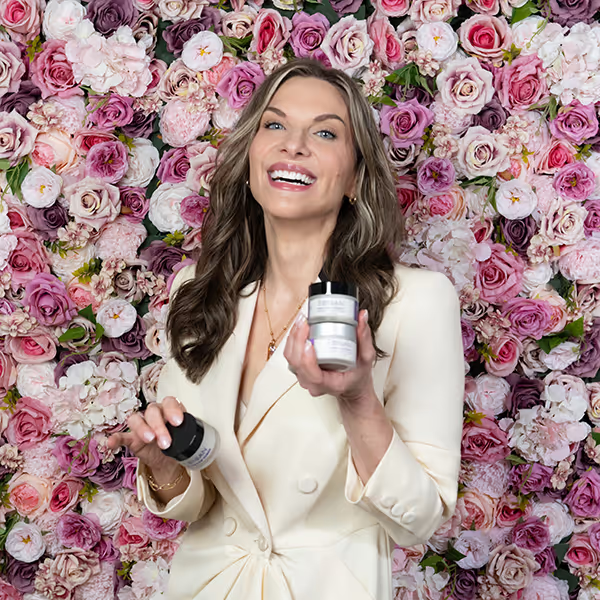
Written by
Danielle Ruess
Founder of Eonian
Skincare for Busy People: What Matters, What Doesn’t, and What Can Wait
If skincare feels more confusing than it should be, you’re not imagining it. For the past three decades, I’ve been reading about, buying and researching skincare products. It used to be that we received our information from trusted beauty magazines that only spoke to dermatologists, estheticians and chemists.
Today, for better or for worse, we are bombarded with influencer routines, ingredient trends, and products launching faster than most of us can finish a bottle of anything. It feels overwhelming and like skincare has become another category where women are expected to keep up. And for entrepreneurs already managing businesses, families, teams, and everything in between, that expectation is unrealistic—and unnecessary.
The good news is that healthy skin doesn’t require constant research or a 10-step routine. It requires understanding a few fundamentals, tuning out the noise, and making decisions based on your skin’s condition, age and environment.
Your Goal: Skin Health, Not Skincare Trends
Most skincare marketing focuses on transformation—before and afters (sadly, most are photoshopped), miracle ingredients (spoiler alert - there are none), and urgency-driven claims (we all know better, but we still can’t resist). What is rarely talked about is actual skin function. It’s boring and doesn’t make a great Meta ad, but it’s important to understand.
When skin is truly healthy, it maintains a strong barrier, which holds and regulates hydration and recovers well from stress (environmental, hormonal, lifestyle).
When those systems are properly supported, skin looks calmer, clearer, and more resilient—often without aggressive intervention. When your barrier is disrupted, no trending ingredient will fix it. If your skin feels reactive, tight, dull, or unpredictable, it’s time to step away from your pile of products and understand that less can be so much more. The following are the top three things I receive the most questions about:
That Smooth, Silky Feeling on Your Skin Doesn’t Reflect What’s Going on Beneath the Surface
Get your products and look at the labels. I guarantee one or more of your products lists ingredients like dimethicone, siloxane and petroleum, which are widely used in skincare. They are in a class of ingredients called occlusives, meaning they cannot be absorbed by your skin. They sit on the surface of the skin to prevent moisture loss if your skin is already moisturized. They cannot be absorbed so cannot moisturize or hydrate your skin. But, in certain situations—being outdoors in dry weather, or used in makeup primers—they can be helpful.
However, current research is leaning more towards moving away from the use of silicones in skincare. And, when looking at your labels, ingredient order matters. Skincare ingredients are listed by concentration, so when occlusives appear at the top of an ingredient list, they make up the majority of the formula. Because these materials are not absorbed into the skin, an important question follows: are the beneficial ingredients listed further down actually reaching your skin—or are they sealed out as well?
This doesn’t make occlusives bad or toxic, but it does underscore why understanding your labels can help you make informed decisions.
Example: Hyaluronic Acid vs. Sodium Hyaluronate:
One of the most common areas of confusion, and one I receive the most DMs about is hyaluronic acid (HA) and sodium hyaluronate (SH). They sound interchangeable, and brands often treat them that way, but they behave very differently on the skin.
Hyaluronic Acid (HA): Surface Hydration Support
HA is a large molecule, meaning it can’t penetrate, so it sits on the skin’s surface. Its primary role is to attract and hold moisture, helping skin feel plump and hydrated.
HA works best when your skin barrier is already healthy, it’s layered under a moisturizer, and when your environmental conditions support hydration.
Important nuance: climate matters. In very dry environments, HA can pull moisture from the deeper layers of your skin. This causes confusion for many women who think they are doing the right thing, only to have their skin feel dryer.
Sodium Hyaluronate (SH): Deeper Hydration Support
Sodium hyaluronate is a salt form of hyaluronic acid with a much smaller molecular size, allowing it to penetrate more deeply into the skin. SH has been clinically shown to provide longer-lasting hydration, support skin elasticity and is often better tolerated by sensitive or stressed skin.
Because it functions differently, SH can be more effective for people experiencing dryness related to stress, hormonal shifts, or environmental exposure.
The problem isn’t which one you use—it’s being sold the idea that one ingredient alone is a universal solution. Healthy skin depends on how ingredients are formulated, layered, and supported, not just what’s on the label.
Why Retinol and Invasive Treatments Can Wait
Retinol has become the skincare equivalent of a badge of honor—something women feel pressured to start using asap to ‘prevent aging’.
But retinol, or anything else you buy, cannot prevent aging. And retinol can damage your skin barrier if you start using it too young, start using it too aggressively or are sensitive to the ingredient.
Retinol is touted as the gold standard but there are many people who simply cannot tolerate it. And, younger skin doesn’t need that level of stimulation. In many cases, barrier support, hydration, and consistency will deliver better long-term outcomes—without irritation, downtime, or inflammation.
The same applies to invasive treatments. I am troubled by the 19-year-old influencer I saw who was microneedling (at home, no less). First, I believe that microneedling with PRP may be the fountain of youth. But, let me explain why it’s not good for younger skin (unless there is a scarring issue; but I’ll leave that to the plastic surgeons). First, never, ever do this one at home. The risk of infection and scarring is high - just Google it for some horrifying photos. The microneedles vibrate at high speeds and puncture your skin, creating thousands of tiny micro-wounds. These wounds stimulate a healing response in the dermis (the deeper layer of your skin), which boosts collagen. If you are in your 20s, you are still producing ample collagen so not only is it a waste of money, you may do damage that will make your skin appear older in the long-term.
Age Does Matter — Because Skin Biology Changes
Age absolutely matters in skincare, and not because skin becomes ‘old’. As we age, the skin undergoes predictable biological shifts; the skin barrier becomes thinner and permeable, your natural lipid production declines, and recovery from irritation takes longer.
These changes mean that aging skin generally benefits from fewer, more nurturing ingredients, rather than aggressive stimulation. Supporting the barrier, maintaining hydration, and prioritizing recovery become far more important than chasing intensity.
This is where I think the industry can do better. Skincare is frequently marketed as one-size-fits-all, implying that the same ingredients and routines work equally well at every life stage. In reality, what skin can tolerate—and what it needs—changes over time.
Younger Skin Can Often Handle More
Younger skin typically has a stronger, faster-repairing barrier, higher natural oil production, and more resilience to irritation. Because of this, younger skin can often tolerate constant switching of products with more aggressive ingredients. But tolerance doesn’t always equal long-term benefit.
Over-exfoliation, constant product switching, and stacking actives may contribute to breakouts, redness, sensitivity, and early barrier damage.
Many of the skin issues younger women experience aren’t signs that they need more products—they’re signs the skin barrier is being stressed.
Two women the same age can have completely different skin needs. Hormones, stress, sleep, environment, and lifestyle all play a role. Your skin doesn’t need to be “kept young.” It needs to be kept healthy.
The Reality of Influencer Skincare
I know, I have my favorites too but the truth is that Influencers are rewarded for novelty - and that doesn’t translate well to skin. Skin thrives on consistency, simplicity, and repetition. Yawn! But, it’s true.
Constantly switching products disrupts the very systems skincare is meant to support. What looks exciting online often creates irritation, confusion, and wasted money in real life.
A Smarter Way to Think About Skincare
You don’t need to know everything, go down every rabbit hole or buy new products every few months. Simply assessing your skin when you wake up in the morning is the best way to start. Do you feel tight and dry? You need more simple hydration and moisturization. Are you red and flaky? Give your retinol and acid serums a rest. Breakouts? Surface breakouts may be a reaction to something in one of your products, or your skin barrier may be damaged. Deep breakouts? Those may be hormonal and best left to the dermatologist.
Taking care of your skin health doesn’t need to be complicated; you just need simple, clean products and consistency. Consistency in entrepreneurship is the key to business success, and it is also the key to lifelong, glowing, healthy skin.
.
About the Author
Danielle Ruess
Founder of Eonian
After 26 years in the corporate world, Danielle founded Eonian Skincare, driven by her personal journey to address skincare challenges she encountered after turning 40. Her search for effective solutions led her to collaborate with dermatologists, functional physicians, estheticians, and plastic surgeons. Frustrated by products that over-promised and under-delivered, she recognized that many formulations lack ingredients truly beneficial for maturing skin.
Eonian Skincare isn’t about chasing youth—it’s about fostering skin health. Every product is thoughtfully crafted with clean, natural ingredients, and are vegan, cruelty-free, and proudly made in the USA. Danielle’s mission is to provide skincare that works in harmony with the skin’s natural processes, offering realistic results for real people.

The Latest

Heather Lillico Helps Burnt-Out Founders Rewire Their Nervous Systems
The former nutritionist burnt out building her nutrition business, and the tools that brought her back to calm now anchor her coaching for women founders.

Elizabeth Watson Helps Founders Recover Their Lost Energy

Automate Your Site with a 1-Month Free Trial
Kartra