















Why High-Achieving Founders Stop Trusting Themselves — And What Actually Shifts It
April 3, 2026

Written by
Ulrika Gustafson
Ulrika Gustafson Advisory
Every woman founder I have ever worked with is some version of the same person.
She's not a beginner. She's already built something real. She's smart, driven, high-achieving. She's done the work. But she's consuming everyone else's playbook, comparing herself to founders who look further ahead, and slowly talking herself out of trusting the very instincts that got her here.
This is one of the most common forms of entrepreneur self-doubt I see: not a lack of capability, but a growing disconnect from your own judgment.
You bought the course. Followed the framework. Studied the people who seem to be doing it better. And somehow, the more you consumed, the further you drifted from the thing that made you start in the first place.
So you listen. To the strategist. The brand coach. The six-figure launch formula. The woman on Instagram who built it all in eighteen months while raising three perfectly adjusted children, jet-setting with her partner, and looking absolutely Zen doing it. No bad days visible. No messy kitchen in the background. Just a carefully curated surface, and you quietly wondering what you're doing wrong.
And slowly, without noticing, you stop listening to yourself.
When Entrepreneur Self-Doubt Gets Louder Than the Signal
Building a business is the first time many of us are truly on our own. No performance review to tell us we're on track. No manager to validate the direction. Just us, the decisions, and the relentless noise of everyone else's highlight reel telling us we're behind.
And the louder that noise gets, the quieter your own voice becomes.
I see this over and over, in the group work I do with founders and in the one-on-one work I do with senior executives. The industry changes. The title changes. But the pattern doesn't. Women who are smart, capable, and genuinely good at what they do, still rewriting the email four times, second-guessing the offer, and going blank before the pitch they've prepared for weeks.
Not because they've lost their ability. Because they've lost their trust in it.
Why High-Achieving Founders Are Vulnerable to Self-Doubt
Here's the paradox. The same drive that built the business becomes the thing that undermines it.
High-achievers don't half-do anything. So when they decide to figure out why things aren't moving fast enough, they go all in. More research. More courses. More studying the people ahead of them. More consuming, more comparing, more optimizing.
And the smarter you are, the more convincing the noise becomes. Because you can always find evidence that someone else is doing it better. That your offer isn't quite right. That your messaging needs another pass. That you're not ready yet.
Perfectionism dressed up as diligence. Comparison dressed up as research. Avoidance dressed up as preparation.
The result? A woman who is genuinely capable, slowly burying her own signal under everyone else's.
Related: Entrepreneur Burnout: Prevention Strategies That Work in 2025
What Founder Self-Doubt Actually Looks Like
A founder I work with said it better than I ever could. We were on a group call when she said: "I've spent so much time trying to build it the right way that I forgot I already knew my way."
The room went quiet. Because every woman in it recognized exactly what she meant.
That's not a confidence problem. That's a trust problem. And they are very different things. Many founders experiencing self-doubt assume they need more confidence when what they're really missing is trust in their own judgment.
What Helps Founders Move Through Self-Doubt
You don't need more information. You need to stop and trust what you already have. For many entrepreneurs, overcoming self-doubt begins by reconnecting with what they already know to be true.
Not quit. Stop. Stop the consumption long enough to remember what you actually think. What you actually see. What made you build this in the first place, before anyone told you how it was supposed to look.
Building a business isn't a walk on the red carpet. It's laughter and tears and zero-income months and powering through anyway. It's messy and nonlinear and often nothing like the roadmap you bought.
The women who find their way through it aren't the ones who found the perfect strategy. They're the ones who stopped outsourcing their judgment long enough to trust their own.
You already know more than you think you do. The question is whether you're willing to listen to yourself again.
If this resonates, I write about self-trust, decision-making, and what it really takes to build something as a woman founder. Follow me on LinkedIn.
Further reading: Main Character Energy: 4 Steps to Own Your Brand Story — Katie Miller Imposter Syndrome in Leadership: Practical Solutions — Natalie Rosado
Details shared with permission.
FAQs
Q: What does entrepreneur self-doubt look like?
A: Entrepreneur self-doubt often looks less like insecurity and more like constant second-guessing. It can show up as over-researching, endlessly tweaking decisions, comparing yourself to other founders, or relying on everyone else's opinions before trusting your own.
Q: Why do successful founders struggle with self-doubt?
A: High-achieving founders are often driven to improve and learn. The challenge is that the same drive can lead to excessive comparison, perfectionism, and a tendency to seek external validation instead of trusting their own experience.
Q: What's the difference between low confidence and self-doubt?
A: Confidence is about believing you can do something. Self-trust is about believing your judgment is sound. Many founders don't lack confidence—they've simply stopped trusting themselves.
Q: How can entrepreneurs overcome self-doubt?
A: Overcoming self-doubt often starts with reducing outside noise and reconnecting with your own experience, instincts, and decision-making process. The goal isn't to know everything—it's to trust what you already know.
Q: Can comparison make entrepreneur self-doubt worse?
A: Yes. Constant exposure to other founders' success stories can make it easy to overlook your own progress. Comparison often amplifies self-doubt by creating the impression that everyone else has figured something out that you haven't.
Updated on: June 12, 2026
About the Author
Ulrika Gustafson
Ulrika Gustafson Advisory
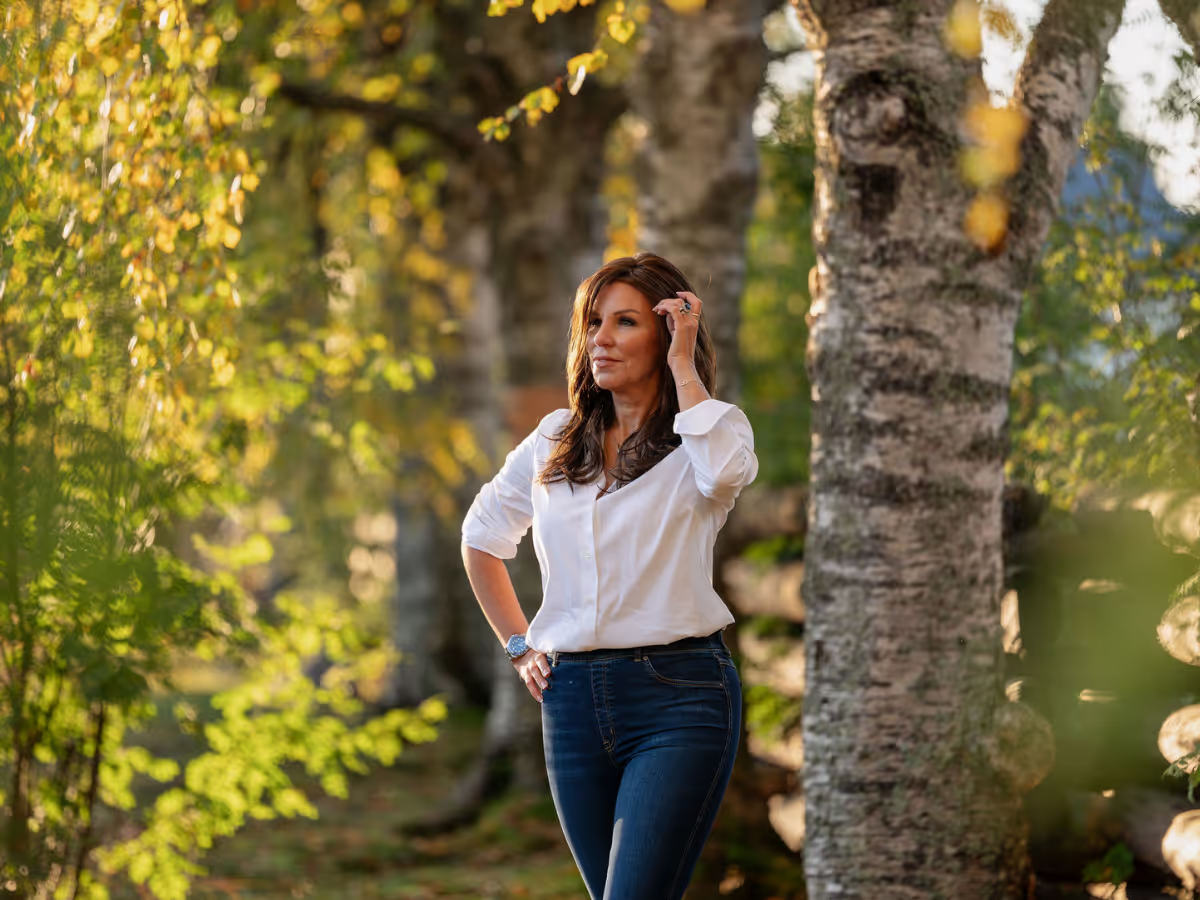
Ulrika Gustafson is a certified Executive Coach (PCC), former attorney, and one of Europe's youngest female City Managers. She launched one of Sweden's first EU-law firms, has served as a C-suite executive, founded three companies, and led organizations from one person to 11,000 employees — through union conflicts, political pressure, and turnarounds across five countries that didn't come with a manual.
She works with senior leaders who are capable, trusted, and quietly questioning themselves more than they should. Her clients include Managing Directors, General Counsels, COOs, and Chiefs of Staff at Fortune 500 companies. She also runs Recalibrated — a 12-week program for women founders and leaders at an inflection point who are solving the wrong problem, and are ready to lead the life, career and business they've already built.
Most coaches teach new skills. Ulrika helps them understand why the ones they already have stopped working. She doesn't coach from theory. She coaches from having been in the seat when one wrong move could cost everything.
She splits her time between North Texas, northern Sweden above the Arctic Circle, and eastern Thailand — with her husband and two Golden Retrievers.

The Latest
Allison Walsh Closes the Authority Gap for Accomplished Women
The founder of She Believed She Could has advised more than 300 private clients on turning expertise and credibility into visibility, influence, and income.
Elizabeth Watson Helps Founders Recover Their Lost Energy

Automate Your Site with a 1-Month Free Trial
Kartra