
.avif)









.avif)

.avif)




How to Tell If AI Is Recommending You (and Why It's Recommending Your Competitor Instead)
A free way to check where you stand in AI search, and what to fix when a competitor keeps getting the recommendation.
September 24, 2026
.avif)
Written by
Jacki DeVries
FireUp AIO
If you’re wondering where you stand with AI visibility, you’re not alone. AI search is still in its beginning phases, which means there’s a massive window of opportunity if you act on it. And this is a good place to start.
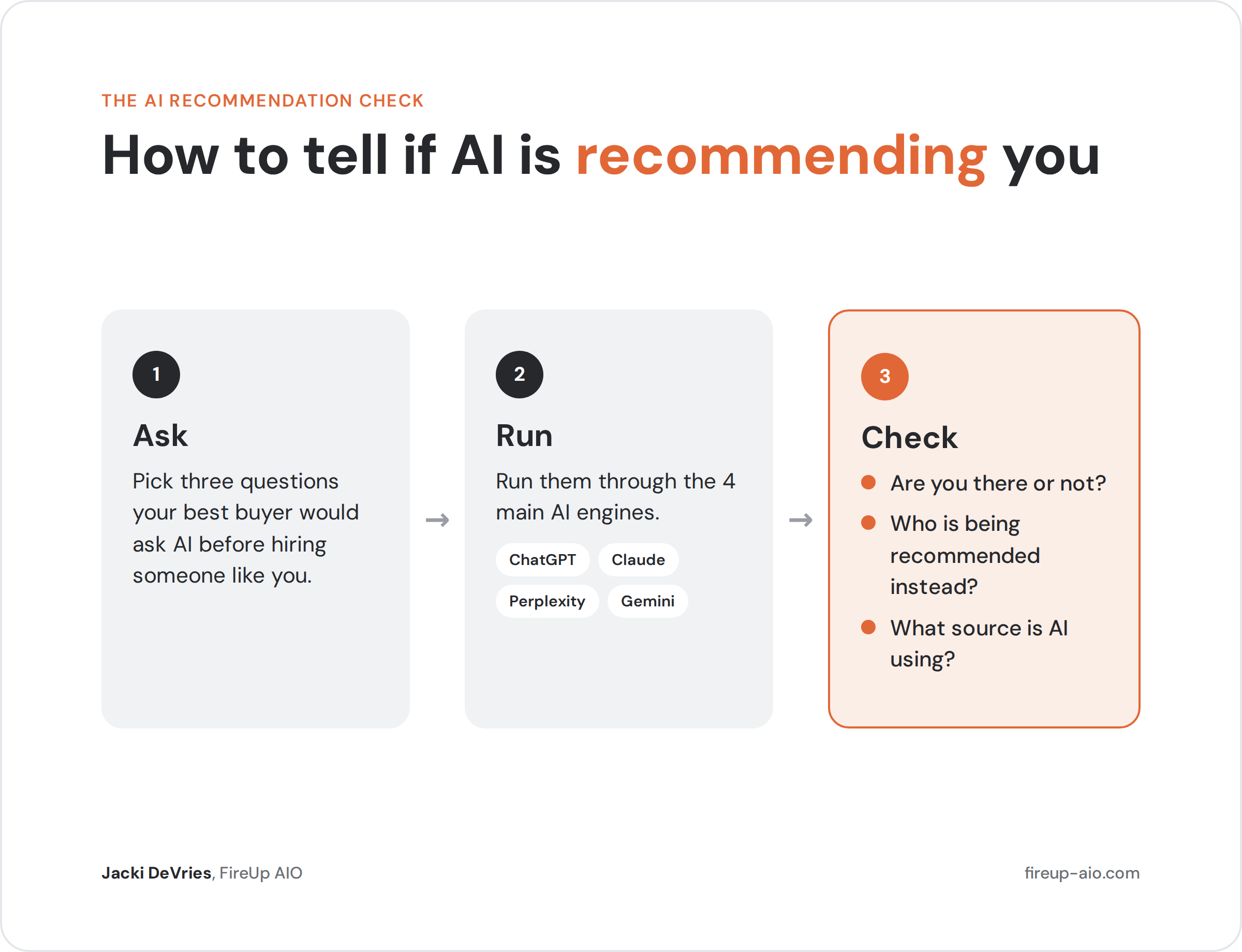
How to tell if AI is recommending you
You don’t need any fancy tools. Pick three questions your best buyer would ask AI before hiring someone like you. Run them through the four main AI engines (ChatGPT, Claude, Perplexity, Gemini), the way they would ask them. Something like “Who is the best [what you do] for [who you help]?” or “I’m a [who you help] looking for [what you do]. Who do you recommend for my type of business?”
Then look at three things:
- Are you there or not?
- Who is being recommended instead?
- What source is AI using? Is it recommending a business because of its own website, or because a third party mentioned it?
I recently ran an audit for a female founder where AI named her business once. Twelve answers across four AI tools, and she showed up in one of them. And AI pulled her one mention from a reputable industry organization’s page about her.
On the flip side, if a competitor’s website keeps showing up across your prompts, that’s a good website to review. What do they have that you’re missing?
Why AI is recommending your competitor instead
Many of the women I work with are doing well on several platforms, and they don’t understand why less experienced companies, or companies with not as much media, are winning the recommendation.
The founder from that audit is a perfect example. She pays a marketing team, has 20 years of experience and a strong LinkedIn following, has a podcast, and posts consistently on three or four other social platforms. She could not understand why AI wasn’t recommending her. The business AI named most often for her buyers was only a couple of years old (founded in 2024), and it came up in five of those twelve answers.
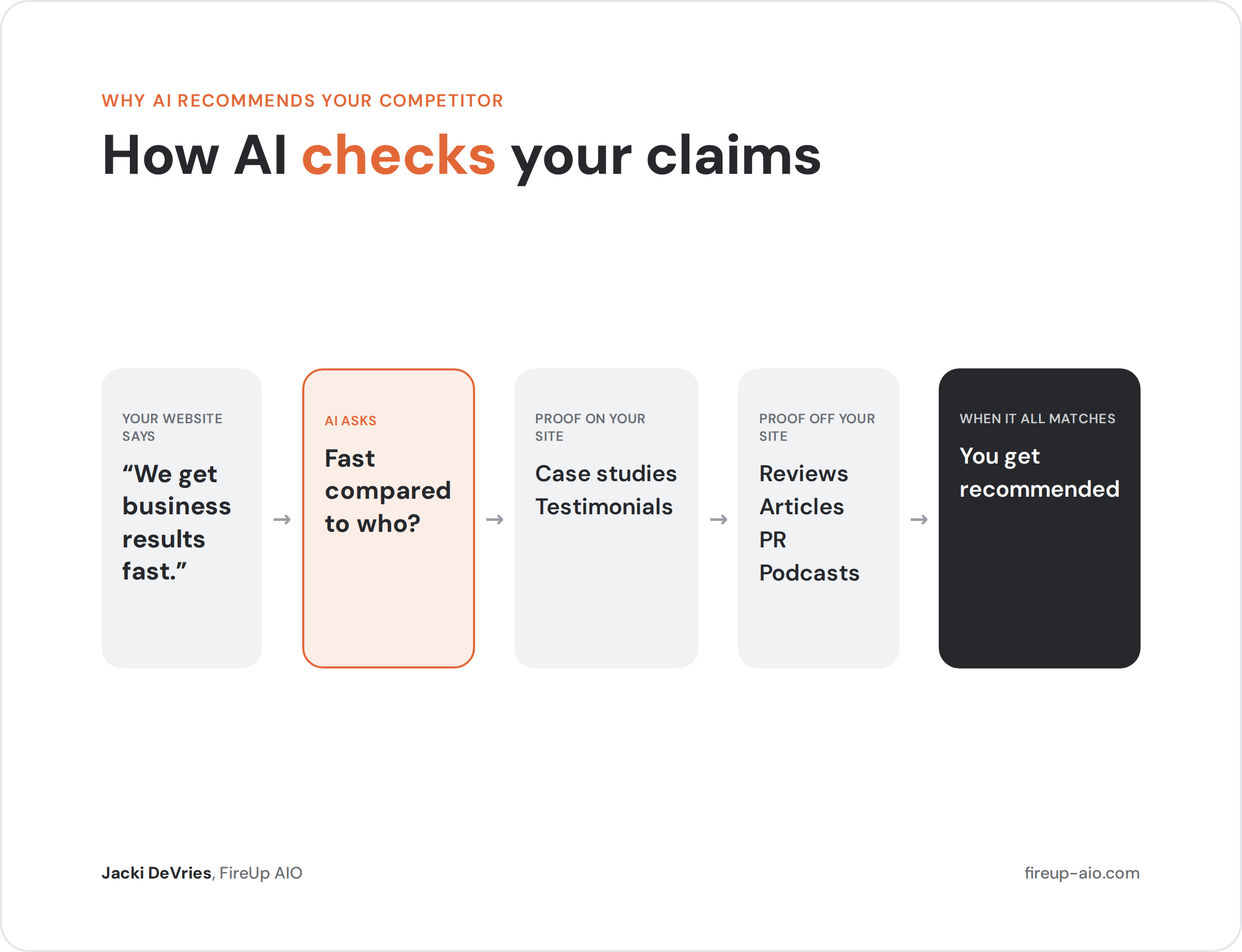
The issue was her website. AI builds a trust profile from everything it can find about your business across the web, on your site and off it. Her website was the weakest link, and depending on your industry and market saturation, it’s the first place AI checks. Then it looks across the web for third-party proof that matches what your website claims.
Say your main message is “We get business results fast.” AI asks, fast compared to who? Is there proof a business actually got fast results? It looks for case studies and testimonials on your site, then for off-site proof that backs up the claim, like reviews, articles, PR, or podcasts.
What AI needs from your website
This is where the FIREUP Framework I use for AI Search Optimization at FireUp AIO comes in handy.
To be found
Foundation: AI needs to access the information on your site. That means fast load times and pages that are easy for AI to read and store (crawl and index).
Intent: AI needs to clearly understand who you are, what you do, who you help, and why you’re the best choice.
To be the answer
Relevance: AI reads your website to extract information, fast. So answer your buyers’ questions on your website with a short, direct answer first, then the supporting evidence underneath.
To be the recommendation
Expertise: Show why you’re the best choice with testimonials and case studies.
Unity across platforms: Keep your brand consistent across your website, social profiles, directories, reviews, and any third-party content about you.
Performance: Do people have a good experience and actually convert on your site?
A good way to improve this is to have one clear call to action per page, especially on your sales pages. If your sales page asks people to read your blog, sign up for your newsletter, take your free assessment, and contact you for pricing, AI (and your buyers) get lost on what that page is supposed to accomplish.

Where to start
Run two free reports to get your baseline.
Google’s PageSpeed Insights: shows how fast your site loads and the overall technical health of your site.
AI Visibility Scorecard: tells you if AI bots are blocked from your site (~35% of sites are) and gives you your top three to five recommended fixes.
If the scorecard can’t be completed, either your site is too slow, or you don’t let AI bots in (the automated programs AI tools send to read your site). That’s what happened to the founder I mentioned. The scorecard timed out on her site before it could finish.
The one thing to do this week
Run your three questions through all four engines and screenshot the answers, sources included. That’s your before picture, and it shows you who you’re competing with in AI search. It may not be who you think.
About the Author
Jacki DeVries
FireUp AIO
Jacki DeVries is the founder of FireUp AIO, an AI search optimization consultancy that helps established businesses become the ones AI recommends when buyers use tools like ChatGPT, Perplexity, and Google AI Overviews to decide who to trust and hire. With 15 years in search strategy, including work alongside industry leader Neil Patel, Jacki built the proprietary FIREUP Framework, a six-pillar system that maps how AI evaluates and recommends businesses.
She is known for translating complex search changes into clear, ethical, measurable strategy for founders and growth teams who are done with hype-driven agencies and reports that do not deliver. Her work helps brands become discoverable by design, earning visibility that compounds over time. Based in Grand Rapids, Michigan, Jacki works with established U.S. and Canadian businesses ready to be found, cited, and chosen in the AI-driven era.

The Latest
.avif)
The Burnt English Muffin Principle: Why Sustainable Success Starts Inward
As women leading businesses, we are deeply conditioned to believe our value lies in high gear. We chase the lightning bolts, assuming fulfillment lives only in the extraordinary. Yet sustainable business success begins with the quiet permission we give ourselves to exhale.
