
.avif)
.avif)
















Before You Spend More on Your Marketing, Here’s How to Break Down Every $100 of Revenue
Learn how to break down every $100 of revenue to understand your true marketing budget, maximum customer acquisition cost, and target ROAS. When you know your profit math, you can make smarter decisions about how much you can actually afford to spend on growth.
October 6, 2026

Written by
Jess Gleim
Jessica Gleim, LLC
Here’s the deal: a $100 sale does not give your business $100 to spend.
I know it sounds obvious when you say it that way. But I regularly see founders and business owners make marketing decisions based on revenue without first looking at how much of that revenue is actually available to spend.
Before you increase your marketing budget, set a target return on ad spend (ROAS), or decide what you can afford to pay to acquire a customer, you need to have a crystal-clear understanding of the economics behind each and every sale.
Start with every $100 of revenue
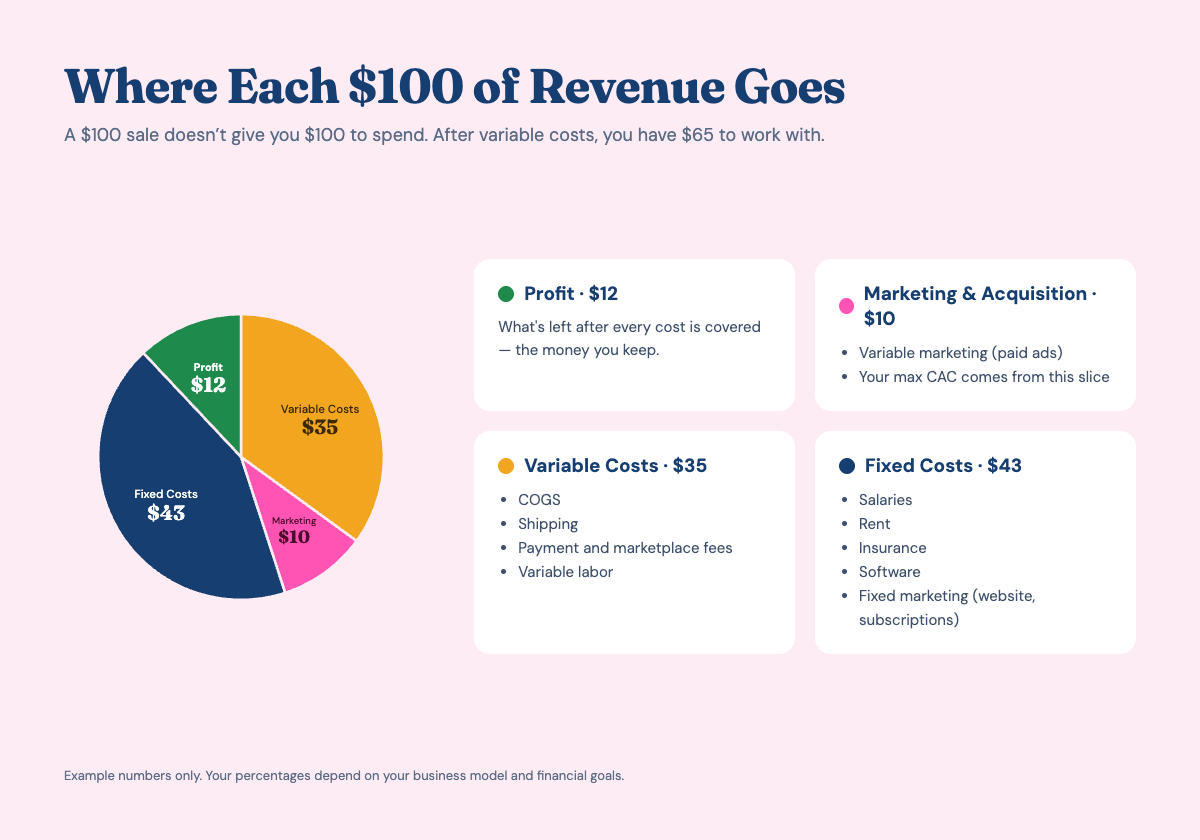
Let’s take $100 of revenue from an average customer and start breaking it apart. I’m using a real example from a real client of mine.
For this example, let's say 35% goes toward variable costs. Depending on your own business, those could include cost of goods sold, shipping, payment processing fees, marketplace fees, or variable labor.
That means the business doesn't really have $100 to work with after making the sale. It has $65.
From there, some of that money needs to cover fixed operating expenses, some needs to become profit, and then only some can be invested back into acquiring customers. (And in my opinion, it should go only to acquiring new first-time customers.)
In this example, the breakdown might look like this:
- $35: variable costs
- $43: fixed costs
- $10: marketing and customer acquisition
- $12: profit
Again, these numbers are only an example. Your percentages will depend entirely on your business model and financial goals. But you can see how this exercise changes the way you think about marketing.
Revenue tells you what you sold. Your profit math tells you what you can afford to spend to create that revenue.
AOV and LTV are not the same as available revenue
You can do this exercise using average order value (AOV) or customer lifetime value (LTV), depending on what you're trying to measure.
But note an important distinction: Neither AOV nor LTV tells you how much you can afford to spend on marketing. Two companies could each have a $200 AOV and have completely different customer acquisition economics.
If one business spends 25% of revenue fulfilling an order and another spends 70%, they cannot afford the same customer acquisition cost simply because their AOV is identical. That is why your business economics must come first, before your marketing metrics.
Work backward to your maximum CAC
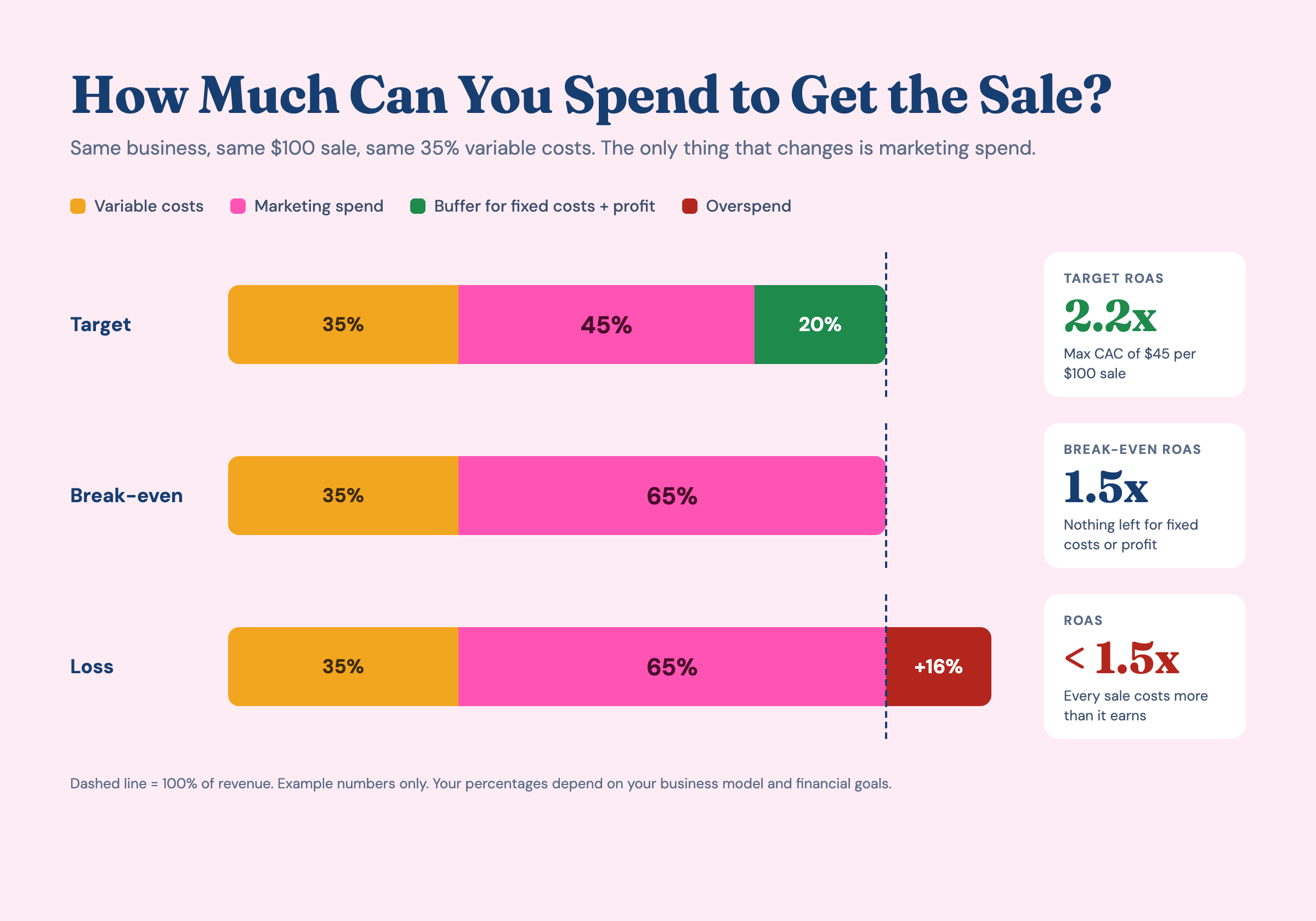
Once you know your variable profit rate, you can decide how much of that margin you're willing to invest to acquire a customer.
Let's use the same business with variable costs equal to 35% of revenue. That leaves a 65% variable profit rate before marketing. If the business spends 45% of revenue on customer acquisition, it retains a 20% buffer. That equates to roughly a 2.2x target ROAS.
At a 65% marketing spend rate, the business reaches approximately a 1.5x ROAS. At that point, marketing has consumed all of the remaining variable profit. Below that threshold, acquiring the sale costs more than the economics of that sale can support. Make sense?
Again, 2.2x isn't a universally "good" ROAS, and 1.5x isn't universally "bad." Those numbers only mean something in the context of this particular business.
Stop asking what a good ROAS is
One of the most common questions I hear is, "What's a good ROAS?" And I’m sorry to say, there's no universal answer.
A 4x ROAS could be highly profitable for one company and insufficient for another. A 2x ROAS could drive profitable growth for one business while losing money for another. Your target ROAS should come from your margins, customer acquisition cost, and profit goals, not an industry benchmark.
The goal isn't to get the highest ROAS. It's to know how much you can afford to spend to acquire a customer while still making money.
Know your numbers before you scale
Before you put another dollar into marketing, break down your own $100, please.
Start with your AOV or LTV. Subtract your variable costs. Decide how much profit you want to keep. Then calculate what's actually available for customer acquisition. Once you know that number, you can set a maximum CAC and target ROAS based on your own business economics.
That's when marketing stops being about chasing revenue and starts becoming a tool for profitable growth, which is exactly what we want.
Related articles by Jess Gleim:
Your Ads Aren’t Profitable. Your Dashboard Just Says They Are.
Why a Post-Purchase Survey Might Be the Most Important Metric in Your Marketing Strategy
The Number I Actually Care About Isn't ROAS
If Rising Ad Costs Break Your Business, Your Ads Aren't the Problem
About the Author
Jess Gleim
Jessica Gleim, LLC
Jess Gleim is a revenue-focused marketing strategist who helps female founders scale sustainably through early six- and seven-figure stages. She works with founders who are done guessing with marketing and want to get crystal clear on what’s actually driving revenue, what’s draining profit (often paid ads), and where to focus and spend to hit their next growth goals. Known for her no-BS, data-led approach, Jess works with founders who want personalized insight, are tired of overpaying agencies, or have learned the hard way that paid ads alone won’t fix a broken strategy.
She uses paid ads as a powerful tool, but only when the underlying organic strategy is solid and enough data exists to support smart decisions. Jess has helped women scale their businesses past the $1M mark and believes growth should feel intentional, not chaotic. She lives in the mountains with her husband and two children and is passionate about helping women make more money in businesses that actually support their lives.

The Latest

ChatGPT Ads Are Here: What Founders Need to Know
New AI-powered tools are making it easier to create, manage, and measure ChatGPT ad campaigns. What founders need to know before getting started.
