











.avif)
Why Most Founders Accidentally Build Businesses That Won't Scale
July 24, 2026
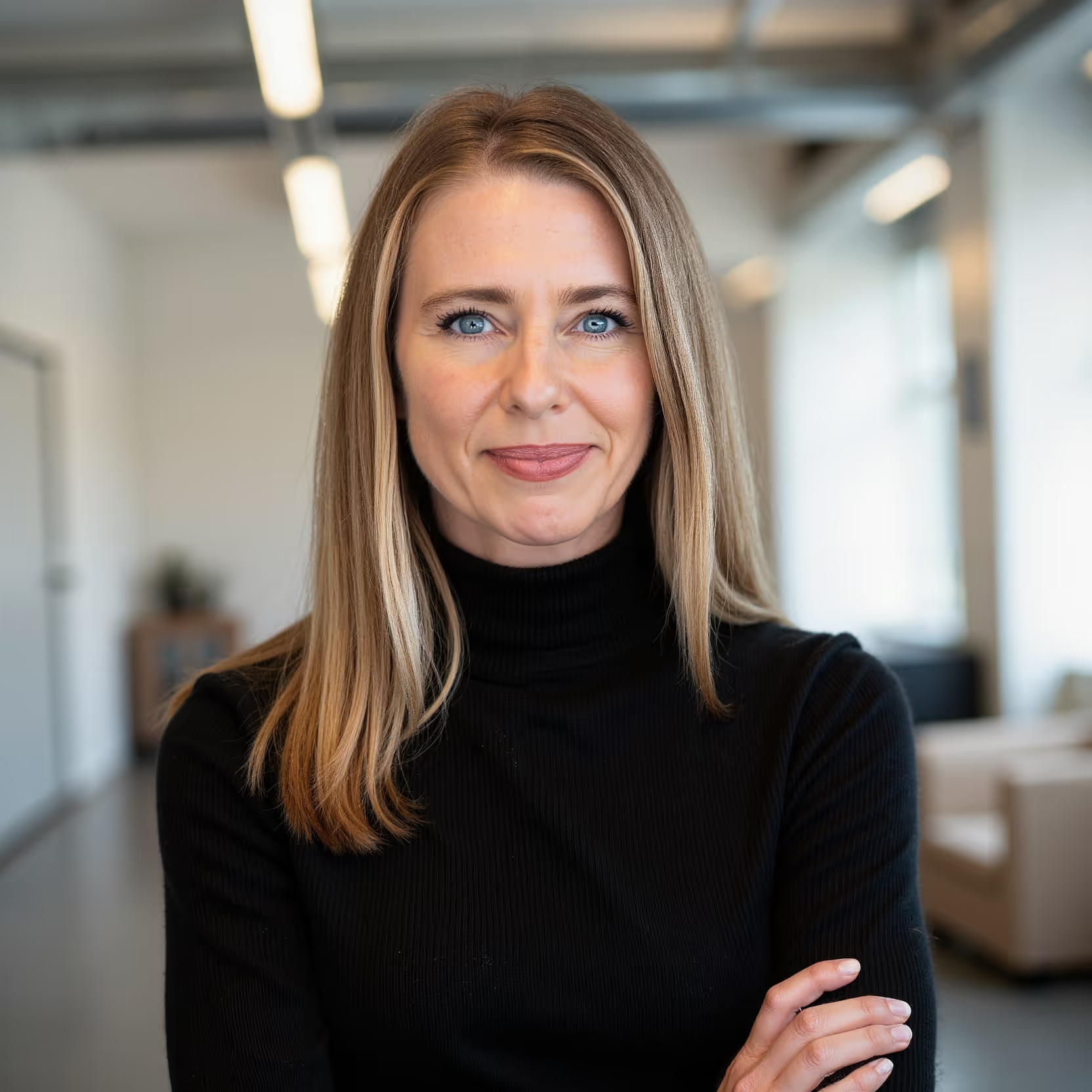
Written by
Jennifer DiMotta
Founder of Uprisors Growth Partners LLC
A founder recently showed me an organizational chart she'd been working on. Every role had been thoughtfully considered, every reporting line made sense, and it was obvious she'd spent hours trying to build the right structure. I studied it for a minute before asking one simple question: "Is this the company you have today, or the company you're trying to build?"
She paused, smiled a little, and finally answered, "The company I have today." That one answer explained far more than the organizational chart ever could.
I see some version of this almost every week. Founders don't intentionally build businesses that won't scale. In fact, they're usually working incredibly hard to prepare for growth. The problem is they're making decisions based on today's reality instead of tomorrow's ambition. They build for the company they have instead of the company they say they want, and over time those decisions quietly become the ceiling on future growth.
The trap is understandable because founders are rewarded for solving today's problems. Someone on the team is overwhelmed, so they hire another person. A customer issue slips through the cracks, so they add another approval step. Communication breaks down, so they schedule another meeting. A high performer has been loyal, so they promote them into leadership. Every decision feels right in the moment because it relieves immediate pressure. The problem is that very few of those decisions are actually designed to support the business they want to build three years from now.
Every hiring decision, every process, every meeting cadence, every leadership role, and every approval either creates capacity for tomorrow or reinforces the limitations of today. None of those decisions feel significant on their own. But stack them together over three or four years, and you've created an organization perfectly optimized for today's revenue, today's customers, today's team, and today's challenges. Then growth arrives, and suddenly everything starts breaking at once.
This isn't just something I've observed in coaching engagements. Research consistently shows that while many companies achieve early success, organizational and leadership challenges become some of the biggest reasons they struggle to scale. Businesses rarely stall because they run out of opportunity. More often, they stall because the way they're built simply can't support the next stage of growth. Likewise, Gallup has found that entrepreneurs who effectively delegate generate significantly higher revenue and create more jobs than those who struggle to let go. Leadership design isn't a "soft" issue. It's one of the biggest competitive advantages a growing business can create.
One founder I worked with proudly shared her three-year vision of doubling the business. The opportunity was absolutely there. Demand was growing, the market was strong, and she had a talented team around her. But when we reviewed how she actually spent her week, a very different picture emerged. She was still approving marketing campaigns, solving customer issues, reviewing invoices, answering HR questions, and sitting in meetings where nearly every important decision still required her input. Her vision said she wanted to become the CEO of a much larger company. Her calendar told me she was still operating like the manager of the company she already had.
That's a disconnect I see far more often than founders realize. We talk about wanting a $20 million business, but our daily decisions are still designed to efficiently operate a $5 million one. We say we want exceptional leaders, yet we continue making every meaningful decision ourselves. We want accountability, but every difficult conversation still ends with the founder stepping in to solve the problem. We want freedom, but we continue designing businesses that require us to be involved in everything. Those two realities can't coexist forever.
Another leadership team I worked with spent nearly an hour debating whether they needed another operations manager. Everyone had opinions about workload, reporting relationships, and organizational structure. Finally, I asked a different question: "What will this business need when you're twice this size?" The room went completely quiet. They had spent the entire conversation trying to solve this quarter's problem instead of designing the organization that would carry them through the next five years. That one question completely changed the direction of the discussion.
Exceptional operators understand something most founders don't realize until much later: the decisions that create today's success are rarely the same decisions that create tomorrow's growth. Early on, speed wins. The founder's willingness to jump in, make every decision, wear every hat, and personally ensure things get done is often exactly what allows the business to survive. But somewhere along the way, those same behaviors quietly become the biggest obstacle to scaling.
I tell founders all the time that your job isn't to build a business that depends on your strengths. Your job is to build a business that performs consistently even when your strengths aren't in the room. That changes how you think about almost everything. Meetings become less about updates and more about decision-making. Scorecards become less about reporting activity and more about measuring outcomes. Leadership roles become less about who is available and more about what capabilities the business needs next. Instead of asking, "Who can take this on?" you begin asking, "What structure gives this business the greatest chance to win?"
That's why exceptional operators seem to make different decisions than everyone else. They aren't simply better leaders. They're designing an operating system instead of reacting to daily events. Every hire, every process, every accountability rhythm, and every leadership expectation is intentionally moving the company one step closer to the business they're trying to build. They're making decisions from the future backward instead of from the present forward.
One of my favorite moments in coaching comes when I ask founders a question they've never considered before: "If you hired a world-class CEO tomorrow, what would they change first?" Almost every founder immediately starts building the list. They'd restructure the leadership team. They'd stop requiring founder approval for every decision. They'd install clearer KPIs, strengthen accountability, simplify meetings, and push ownership deeper into the organization. Within minutes they've described exactly what the business needs. Then I ask the follow-up question: "So why are you waiting?"
That question usually changes the conversation because the goal isn't to someday bring in a CEO who knows how to scale the business. The goal is to start making the same decisions that CEO would make today. Every month you delay those decisions is another month spent reinforcing the very systems you'll eventually have to undo.
Over the years, I've realized that the founders who scale the fastest aren't necessarily making more decisions than everyone else. They're simply using a different filter when they make them. They have a way of pressure-testing today's decisions against tomorrow's ambitions before they ever commit to a path. That's exactly why I developed what I call The Tomorrow Test™.
Before making any meaningful decision, ask yourself four questions. Would I build it this way if my company were twice this size? If the answer is no, you've probably designed a temporary solution instead of a scalable one. Am I solving today's problem or designing tomorrow's capability? Solving today's problem often feels productive because it removes immediate pressure. Designing capability creates future capacity. Does this increase founder dependency or reduce it? Every approval process, meeting, responsibility, and decision either teaches the business to rely on you more or teaches it to operate without you. Finally, if I hired a world-class CEO tomorrow, would they keep this decision? Most founders already know the answer. They simply haven't given themselves permission to make it.
When founders begin running their decisions through those four questions consistently, something interesting happens. They stop making choices that simply make today easier and start making choices that make the next three to five years possible. They begin designing instead of reacting. They stop building around today's limitations and start building toward tomorrow's opportunities.
I don't believe businesses outgrow their founders. I believe founders eventually outgrow the way they've always built businesses. The founders who continue scaling aren't necessarily smarter than everyone else. They don't have fewer problems, more funding, or better luck. What they do have is a willingness to stop designing a business around today's realities and start intentionally building for tomorrow's opportunities.
Every hiring decision is a design decision. Every meeting is a design decision. Every process, leadership role, approval, scorecard, and expectation is shaping the company you'll be running three years from now. The question isn't whether you're building a business every day. You are. The real question is which business are you building? The one that's perfectly designed for today's challenges, or the one that's ready for tomorrow's opportunities?
Because the businesses that scale aren't built by accident.
They're designed that way.
About the Author
Jennifer DiMotta
Founder of Uprisors Growth Partners LLC
Jennifer DiMotta is a founder, operator, and executive coach who knows what it takes to scale when things aren’t perfect—just possible. With a career built on grit and growth, she’s helped build powerhouse consumer brands by leading eCommerce growth across seven companies—ranging from 5x to 16x. As a founder of Uprisors and co-host of the From Grit to Growth podcast, she helps entrepreneurs scale DTC, Amazon, and wholesale businesses through profit-focused strategy, operational discipline, and clear-eyed decision-making.
She also founded Uprisors, a leadership development firm for high-performing executives ready to break through to the next level. Jennifer is a public company board member and the upcoming author of The Next Controllable Step, a bold playbook for building momentum in messy seasons. She’s known for her no-fluff leadership style, strategic clarity, and belief that progress isn’t about waiting for perfect conditions—it’s about taking the next step with purpose.

The Latest
Vivrelle: How the Luxury Accessory Club Started With “I Do”
Who started Vivrelle? Meet co-founder Blake Geffen who turned her wedding-day idea into a premier luxury membership club for designer bags and jewelry.
Lara Bruner Teaches Women The Science Of Influence

Automate Your Site with a 1-Month Free Trial
Kartra