













The Hidden Costs of Cheap Packaging
And What It's Actually Costing Your Brand
April 29, 2026

Written by
Julie Rotuno
CEO of Mid-Atlantic Packaging
Picture this: a customer has just discovered your boutique—maybe through Instagram, a friend's recommendation, or a happy afternoon of browsing. They have fallen in love with your soaps, your hand-poured candles, your curated line of artisan goods. They bring their purchase to the counter, ready to buy, maybe even to give as a gift. And then it goes into a plain brown bag. No tissue peeking out the top, no ribbon, nothing that makes them feel good about carrying it out the door.
By the time they step out onto the sidewalk, you have communicated something about your brand. And what you said—without even meaning to—is that the experience ends at checkout.
What I Actually Mean by “Cheap” Packaging
When we talk about cheap packaging, we are not simply talking about price per unit. We are talking about intention, or more specifically, the absence of it.
Cheap packaging is chosen because it was the fastest, easiest, lowest-cost option, with no consideration for what the customer will feel when they encounter it. It is the tissue paper that wrinkles and rips the moment it's handled, a flimsy corrugated mailer, or the absence of a handwritten thank you card. Nothing about the experience says: We wanted this to feel special for you.
And that cheap packaging also tends to arrive damaged, because materials chosen without care rarely survive a modern supply chain. Returns cost you twice: once on the replacement and once on the relationship. But the damage I want to talk about goes far deeper than what happens to the product inside the box.
The real cost of cheap packaging is what it quietly does to your brand, your perceived value, and your customer's decision to ever come back.
First Impressions Are a Brand Event
You have thought carefully about your product. You have agonized over your logo, your brand colors, the way your shop looks and feels. You have done the work of building something worth noticing. Packaging is where all of that work either gets honored or quietly undermined.
Think about what it feels like to pull the ribbon on a beautifully wrapped gift, lift the lid off a well-made box, and part the tissue to find what's waiting inside. These moments are not accidents—they are decisions. And they create feelings that attach themselves to a brand and stay there long after the product is unwrapped.
There is a deeply human tendency to equate how something looks with how good it is. A candle in a matte black vessel with a hand-lettered label feels more luxurious than the same candle in a plain glass jar with a generic sticker—even if the wax, the wick, and the fragrance are identical. We know this intellectually and yet we still feel it, every time. When perceived value rises, price sensitivity drops. A customer who feels that a brand has gone above and beyond is less likely to comparison shop, less likely to balk at your price point, and far more likely to feel that what they paid was absolutely worth it.
Your product worked hard to earn its place in your shop. Your packaging should carry that same standard across the finish line.
The Real Cost of Generic, Unbranded Packaging
Generic packaging is not neutral. It is not simply the absence of branding, but a marketing opportunity—and one you cannot afford to keep missing.
Think about the gift shop that carefully curates every item on its shelves—local pottery, hand-dyed scarves, small-batch preserves. A customer walks in, selects a beautiful ceramic mug, and hands it to the owner to wrap as a gift. If it goes out in an unmarked brown box with crinkle filler and a packing slip, the shop disappears the moment the wrapping comes off. The recipient has no idea where it came from. A potential loyal customer, someone who held your product and loved it, was introduced to nothing.
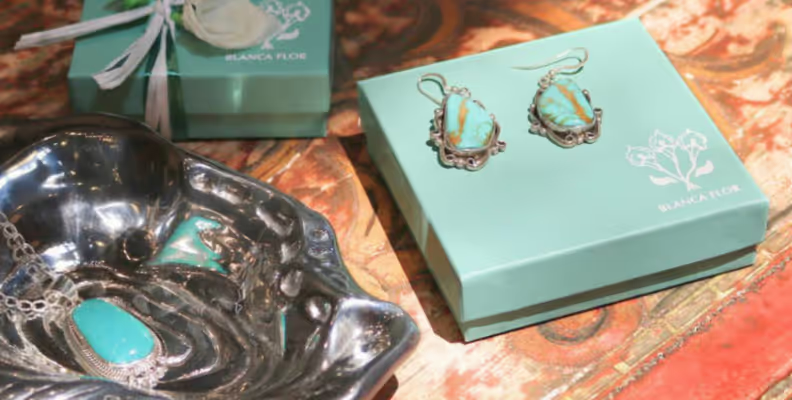
Now imagine that same mug nestled in a branded box, cushioned in crinkle cut shred and tissue the color of sea glass, with a small card bearing the shop’s name, its story, and a handwritten note. The recipient now knows where it came from, they visit the shop at the next opportunity, and buy something for themselves.
This is where customization becomes not a luxury but a strategy. A custom mailer printed with your logo. Branded tissue in your signature color. An insert card with your story and social handles. None of these are expensive in isolation, but together they transform a transaction into an introduction—and an introduction into a relationship.
At Mid-Atlantic Packaging, this is exactly the work we love doing with our clients. Finding the version of branded, intentional packaging that fits their budget, their aesthetic, and their customer. Custom boxes, printed mailers, branded tissue and ribbon, inserts that reflect a brand’s voice: these are the tools that turn first-time buyers into people who remember you, talk about you, and find their way back to you.
Your packaging should be recognizable. It should be yours.
Intention Is the Differentiator
In a marketplace full of noise, intention stands out. The business owners who build lasting customer loyalty are not always the ones with the biggest budgets. They are the ones who asked: what do I want my customer to feel when this reaches them? And then made every decision in service of that answer.
Your packaging is part of your brand. It is part of your story. It is one of the most human touchpoints you have in what can sometimes feel like a very transactional world. And getting it right does not require a complete overhaul—it just requires intention.
If you’re not sure where to start, that’s exactly what we’re here for. Let’s talk about what your packaging could be saying about your brand—and how I can help it say something worth remembering.
About the Author
Julie Rotuno
CEO of Mid-Atlantic Packaging
Julie Rotuno is the second-generation CEO of Mid-Atlantic Packaging, where she helps independent retailers and product-based founders elevate their brands through strategic packaging. From custom retail bags and boxes to branded shipping materials and swag packaging for merchandise and promotional products, Julie works with businesses to turn everyday packaging into a powerful extension of their brand experience. With deep roots in the retail packaging industry, Julie believes that packaging is one of the most overlooked, yet most impactful, marketing tools a business has.
She frequently shares insights on packaging strategy, brand presentation, and how thoughtful packaging can increase perceived value, strengthen brand recognition, and create memorable unboxing experiences. Julie is passionate about helping founders understand how packaging can support both brand storytelling and business growth, whether they’re selling in boutiques, online, or through wholesale channels. Outside of the business world, Julie is a proud mom to two teenage girls and is married to an Air Force veteran and fellow entrepreneur, which has shaped her deep appreciation for resilience, leadership, and building a meaningful legacy through business.

The Latest

A Founder’s Guide to SEO and AEO: 7 Ways to Help Your Business Get Found
A founder-friendly guide to creating content that helps your business get found in traditional and AI search.
.png)
Jennifer Tsay Creates A Business Nearly 1,000 Photographers Count On

Automate Your Site with a 1-Month Free Trial
Kartra