













A Founder’s Guide to SEO and AEO: 7 Ways to Help Your Business Get Found
A founder-friendly guide to creating content that helps your business get found in traditional and AI search.
October 27, 2026
Written by
Daniella Murphy
Copywriter
How people search is changing. Your customers are looking beyond Google. They're using ChatGPT and other AI-powered tools for input on what to buy, who to hire, and how to solve their problems. For founders, that means thinking differently about how and where your business gets discovered.
SEO (Search Engine Optimization) helps common search engines (e.g., Google) better understand your content, so it has a higher chance of being shown when someone searches for a related topic.
AEO (Answer Engine Optimization) helps AI-powered search and answer tools (e.g., ChatGPT) understand your content and could use it when responding to questions.
SEO and AEO aren't interchangeable, but they have a lot in common. Both benefit from clear, useful, trustworthy content that answers your customers' questions.
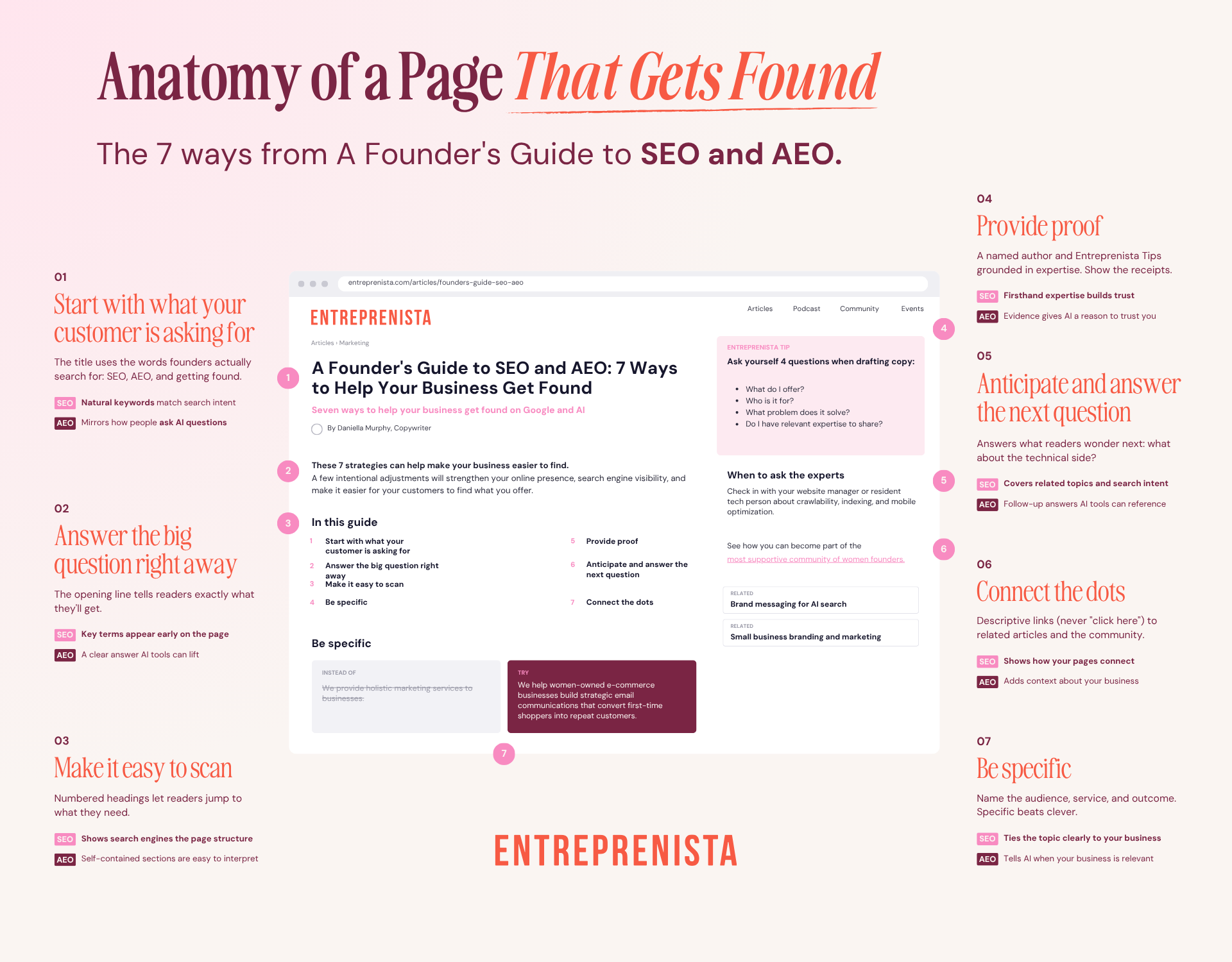
Seven ways to help your business get found on Google and AI
These 7 strategies can help make your business easier to find. A few intentional adjustments will strengthen your online presence, search engine visibility, and make it easier for your customers to find what you offer.
1. Start with what your customer is asking for
Put yourself in your customers’ shoes. What words is she typing into Google? How might she ask a question to ChatGPT? Think about what she wants to find, understand, or solve. That’s search intent: the reason behind her search, whether she’s exploring a solution or looking for an answer to a specific question.
For example:
Google: “Best CRM for a small business?”
ChatGPT: “What is a good CRM for a solo business owner who needs something simple and affordable?”
Both searches offer clues about what your customers need. Keyword research helps you identify the words people search for, while conversational questions reveal more about the problems they're trying to solve. Entreprenista Tip: Naturally position the keywords your customers are searching for in your website copy rather than stuffing them on a page that doesn't reflect your brand.
Your content might say:
How to choose the best CRM for your small business
The best CRM for a small business is one that fits your team size, budget, and your approach to customer relationships. For solo founders and small teams, look for a simple CRM with an affordable monthly plan, easy setup, contact management, and automation features you'll actually use. Before choosing one, consider how many customers you manage, which tasks take up the most time, and whether the platform can grow with your business.
SEO: It naturally uses relevant language such as best CRM, CRM for small business, simple CRM, and affordable, while directly matching the searcher's intent.
AEO: It immediately answers the question in natural language, provides specific criteria, and gives AI enough context to understand who the advice is for and why those features matter.
The takeaway? Don't write one version for Google and another for AI. Write the clearest, most useful answer for your customer.
2. Answer the big question right away
When it comes to SEO and AEO, clear answers are your friend. You may be tempted to set a scene or get clever with your main message. Don’t. Your customer doesn’t want to dig through 6 paragraphs for their answer. Entreprenista Tip: Think of it like giving advice to a friend. Answer her question first, then explain the why and how.
Your content might say:
How to choose the best skincare products for your skin type
The best skincare products for you depend on your skin type, concerns, and goals. If your skin type is more oily, you need to use lightweight moisturizers that won’t clog pores. For more dry skin, look for ingredients that add moisture back into your skin and contain ingredients like hyaluronic acid and ceramides. You don’t need an overly complicated routine. Focus on a cleanser, moisturizer, and wearing daily sunscreen that works for your skin type.
SEO: The headline includes common search words like skincare products for your skin type, while the content uses keywords like dry skin, oily skin, and moisturizer. These terms help search engines understand what the page is about and can help match it to searches.
AEO: The very first sentence in the paragraph answers the question in the headline. The rest of the content provides supporting information for the different skin types. This clear question and answer format makes it easy for AI-powered tools to find useful information and possibly use it in a response.
The takeaway? Lead with the answer, not a long introduction. You can tell the rest of the story after you've given your customer what she came for.
3. Make it easy to scan
Bottom line: Page structure matters. Make it easy for customers to find what they are looking for, and bonus points for a well-organized page that supports your SEO and AEO. Always use a clear page title, descriptive headings and subheadings, and short, skimmable paragraphs. When appropriate, incorporate numbered steps for processes and tables to show comparisons.
SEO: Helps search engines understand the topic and structure of your content.
AEO: Clear, self-contained sections make information easier for AI tools to interpret.
The takeaway: Make your content easy to navigate. If your customer can quickly find what she needs, then search engines and AI tools can too.
4. Be specific
When it comes to helping customers find your business, specificity beats clever every time. Go beyond generic marketing language and be clear about exactly who you are and what you do for your customers.
Instead of: We provide holistic marketing services to businesses.
Try: We help women-owned e-commerce businesses build strategic email communications that convert first-time shoppers into repeat customers.
This identifies the audience, service, and business outcome without making the reader guess.
Entreprenista Tip: Ask yourself 4 questions when drafting copy:
- What do I offer?
- Who is it for?
- What problem does it solve?
- Do I have relevant expertise to share?
SEO: Creates a clear connection between the topic and your business.
AEO: Gives AI-powered tools more context to understand when your business is relevant to someone’s search.
The takeaway: Prioritize clear, useful content that accurately describes your products or services.

5. Provide proof
Give your customer a reason to trust your business. Add proof. Think: testimonials, research, statistics, expert perspectives, case studies, or links to reputable sources. Your product or service solves your customer's problem. Make her believe it.
SEO: Unique examples, credible sources, and firsthand expertise make your content more useful and trustworthy for readers.
AEO: Supporting details and evidence give AI-powered tools more context when interpreting information about your business and a reason to trust you.
The takeaway: Show the receipts and don’t be afraid to brag about your business. Give them a reason to believe you’re great at what you do.
6. Anticipate and answer the next question
Think about what your customer might ask next. Chances are, you already know the answer. Work those answers into your content so customers can find everything they need in one place. Entreprenista Tip: An FAQ page is a great way to answer questions you know are coming.
SEO: Covers search intent and related topics.
AEO: Answering conversational follow-up questions gives AI-powered tools more useful information to potentially reference in their responses.
The takeaway: If you answer what, also answer how, and most importantly, where customers can engage with your product or service. Don't stop at the first question. Think about what your customer needs to know next, and give her a reason to keep exploring.
7. Connect the dots
Good content shouldn’t stand alone. Linking your content to relevant pages on your site or trustworthy external sources provides search engines and AI tools with important context about your business. Be clear and detailed when you include relevant resources to support your content.
Instead of: Click here to learn more about our community
Use: See how you can become part of the most supportive community of women founders
SEO: Links on your page to your own website help search engines understand the connection between your website pages.
AEO: Relevant links provide additional context about your business and connect related information, but know, links alone don't guarantee AI visibility.
The takeaway: Think of your website like a spiderweb, with each page as a connection poin, the strongest connections link related pages in ways that make sense for your customers. Relevant links help them find what they need before they know they need it, and give search engines a better picture of how your content fits together.
When to ask the experts
Great content can't shine online for SEO and AEO if your website is playing hide-and-seek with search engines and AI tools. Check in with your website manager or resident tech person about crawlability, indexing, and mobile optimization to confirm that your most important content is accessible to search engines.
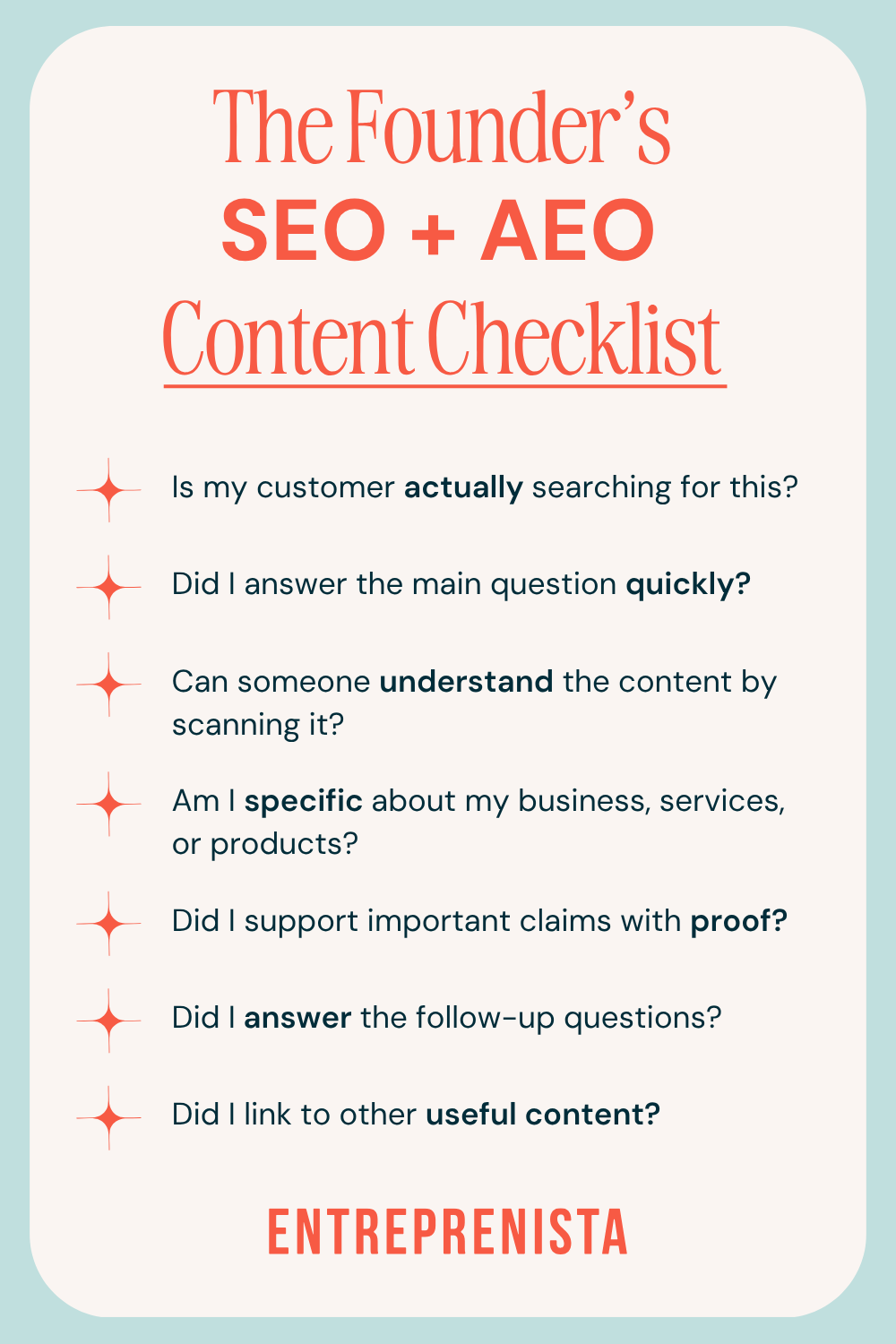
The opportunity for Entreprenistas
Remember, you don’t have to create something from scratch to stay relevant with SEO and AEO. This is the perfect opportunity to give your website a refresh, one page at a time.
Not sure whether AI is finding your business in the first place? Entreprenista Expert Jacki DeVries shares a simple test founders can use to see whether AI tools are recommending their business.
Your next customer is searching for you. The question is whether you are helping her find you. Start with what you already have. Make it easier for your customers to find the answers they need and discover how your business can help.
About the Author
Daniella Murphy
Copywriter
Daniella Murphy is a writer, content strategist, marketing leader, and co-founder with a career spanning higher education, digital media, and film and television. As the owner of a boutique fitness studio, she has firsthand experience establishing a brand, growing a community, and navigating the realities of building a business. With a storyteller’s perspective and a strategist’s eye, Daniella translates complex ideas into clear, engaging content that helps brands connect with the people they want to reach.

The Latest

A Founder’s Guide to SEO and AEO: 7 Ways to Help Your Business Get Found
A founder-friendly guide to creating content that helps your business get found in traditional and AI search.
Adley Kinsman, Viralish: Mastering Visibility and Viral Content

Automate Your Site with a 1-Month Free Trial
Kartra